
Roof Leaking Only in Heavy Rain? What That Actually Tells a Roofer
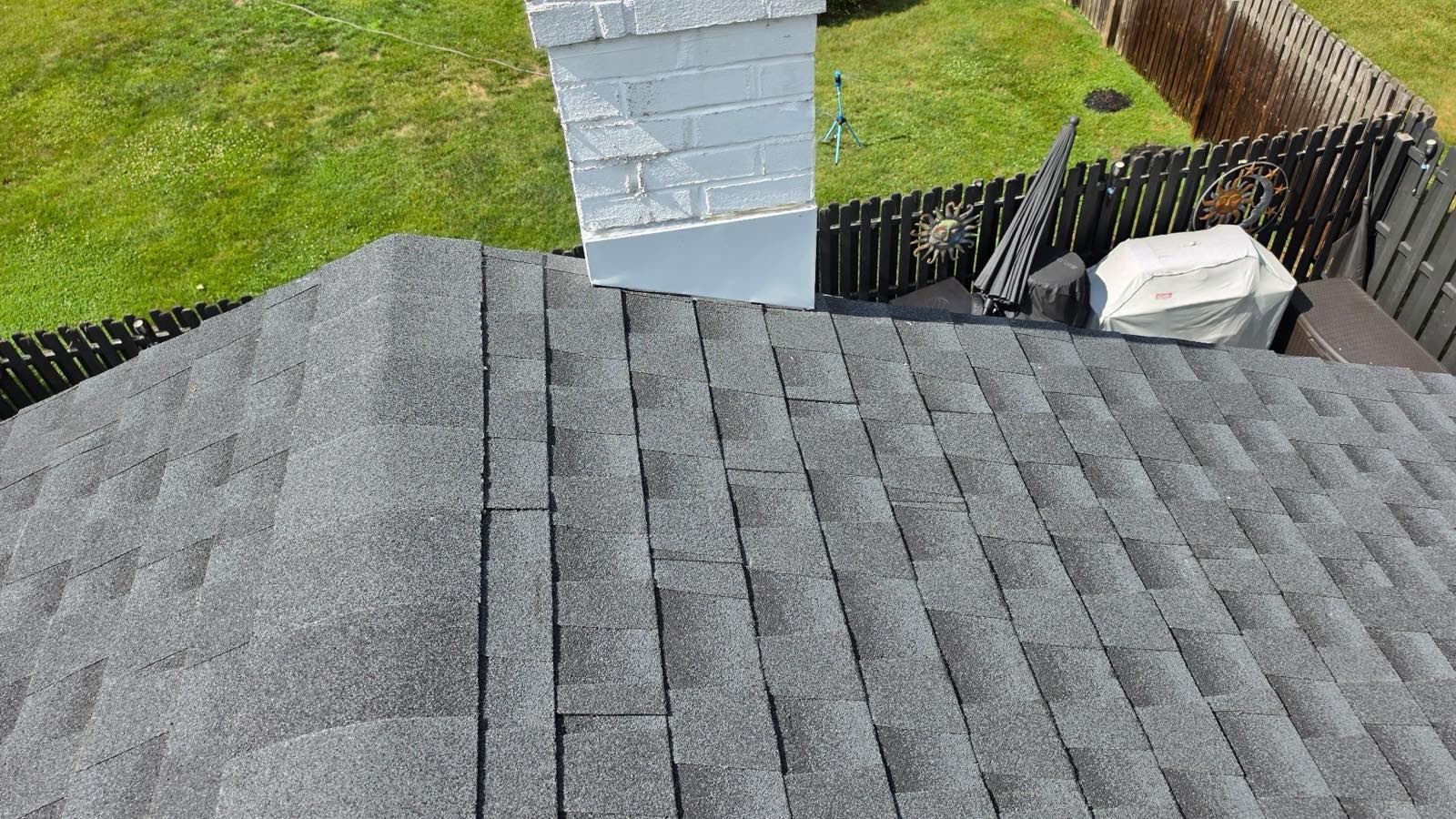
If your roof only leaks in heavy or wind-driven rain, the roof field is usually not the problem. Shingles shed water that runs down them; they are not a sealed membrane, and they are not asked to be. A leak that appears only when the weather gets serious almost always means one of two things: water is being driven at a vertical surface — chimney flashing, a roof-to-wall junction, siding or a window above the roofline — or volume is overwhelming a path, like a valley, a blocked gutter, or a hole small enough that ordinary rain never fills it. The pattern of when it leaks narrows the search faster than an hour of looking.
Green Apple Roofing is a licensed, bonded and insured New Jersey roofing contractor (NJ Lic. #13VH11318100), GAF Master Elite® certified, with 24-hour response across Monmouth and Ocean counties. We diagnose before we quote, and we say so when the answer is not a roof job.
What "only in heavy rain" rules out
It largely rules out the open field of the roof. A hole in the middle of a slope leaks in any rain, because water is running over it every time. If your ceiling only stains when the rain is sideways or sustained, something is either being pushed uphill against gravity — which is wind — or is arriving faster than a detail can handle, which is volume. Everything below follows from that split.
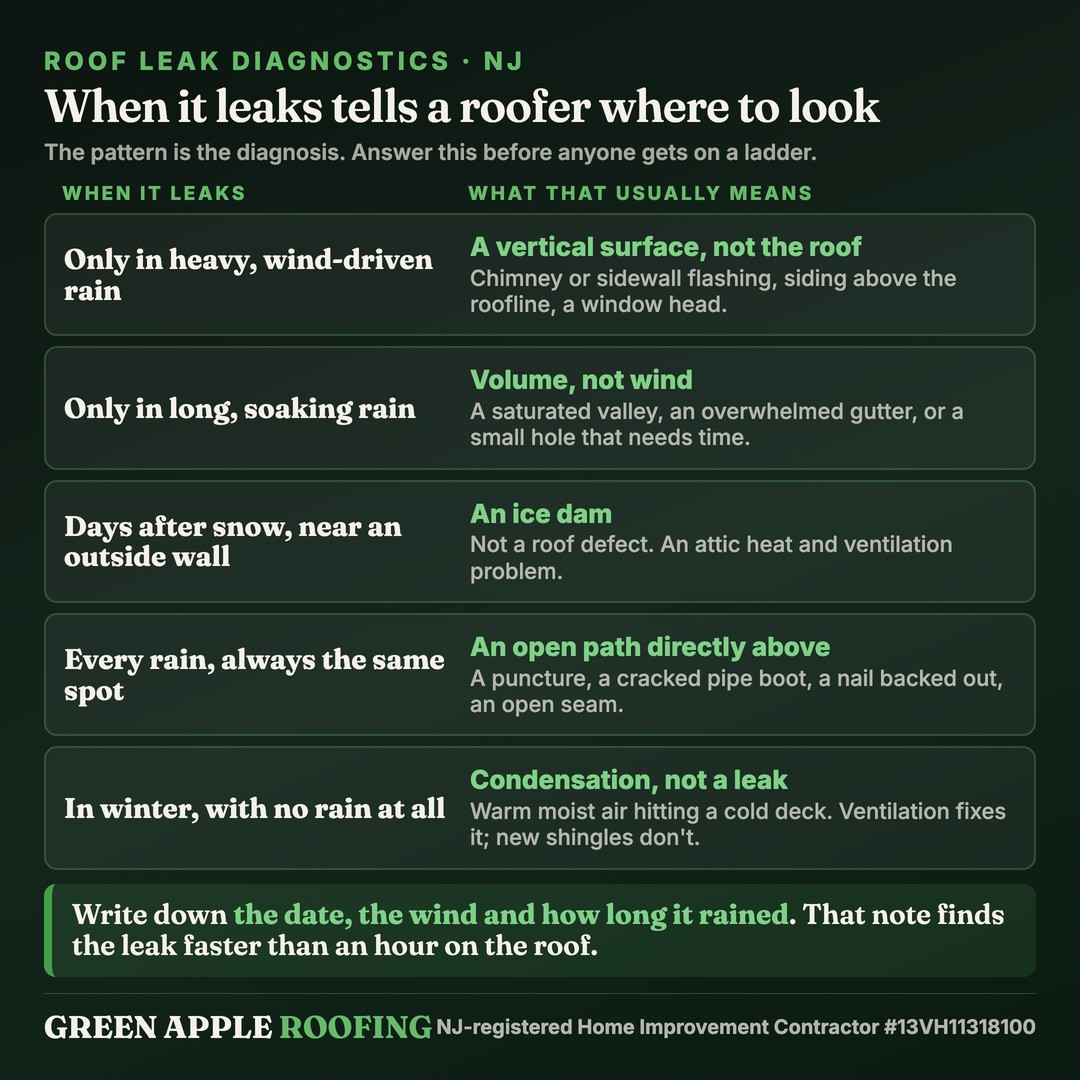
The five suspects, in order of likelihood
1. Chimney flashing
The most common answer, by a distance. A chimney needs two pieces of metal working together: step flashing woven into each course of shingles up the sides, and counter-flashing let into the masonry above it so water running down the brick is thrown out over the step flashing rather than behind it. When the counter-flashing has been surface-caulked instead of let into a cut joint — very common — the caulk fails in a few years and heavy rain finds the gap. The photograph at the top of this page is what correctly detailed chimney flashing looks like.
2. A missing kick-out at a roof-to-wall junction
Where a roof slope runs into a sidewall and stops at a gutter, there should be a kick-out flashing at the bottom — a small bent piece that throws water out into the gutter instead of letting it run straight down behind the siding. It is left off constantly. Nothing happens in light rain. In heavy rain, water pours behind the wall, and because it is inside the wall cavity nobody sees it for years — by which time the sheathing and the framing behind it have gone. If your leak shows up on a wall rather than a ceiling, look here first.
3. The valley
A valley collects the water from two roof planes and concentrates it into one channel. In normal rain the channel copes easily. In a downpour the flow can run wide of the valley metal, or find a nail that was driven too close to the center. Valleys are also where debris collects, and a valley half-full of pine needles behaves like a dam. Both are visible to anyone standing on the roof, which is why this one gets found quickly.
4. A skylight
Skylights leak in heavy rain for two very different reasons, and they need separating. A failure at the curb or the flashing kit is a roofing problem and a real leak. Water on the inside of the glass in cold weather is usually condensation, not a leak, and it means the room is humid and the unit is old. Ours is the roofing half; the units and what they cost are in skylights in NJ.
5. The gutter — which is not a roof leak at all
A gutter that is blocked, undersized or pitched badly overflows in heavy rain. Water then sheets down the fascia, gets behind it, and appears inside at the top of a wall. It looks exactly like a roof leak from indoors and it is nothing of the kind. If your leak is confined to the perimeter of the house and only during downpours, clear the gutters before you buy any roof work. A missing or reversed drip edge makes the same thing worse — see under the shingles.
Wind or volume? How to tell which one you have
| If it leaks… | You are looking at | Start with |
|---|---|---|
| Only when rain is blowing from one direction | Wind-driven water against a vertical surface | Flashing on that elevation, siding, window heads |
| Only after an hour or more of steady rain | Volume overwhelming a path | Valley, gutters, a small opening in the field |
| In any rain, same spot every time | An open path directly above | Pipe boot, puncture, backed-out nail, seam |
| Days after snow, along an outside wall | An ice dam, not a defect | Attic heat, insulation and ventilation |
| In winter with no precipitation | Condensation on a cold deck | Attic ventilation and bath-fan ducting |
The last two rows matter because they are the two that get misdiagnosed as roof failures and "fixed" with a new roof. The winter-thaw pattern is an ice dam, and the dry-winter-damp pattern is condensation — both live in the attic, and both are covered by getting the ventilation right.
What to write down before you call
- The date and time it appeared, and whether the rain had been falling for minutes or hours.
- Which way the wind was blowing. If it only ever happens on a nor'easter-style wind from one quarter, that names the elevation.
- Exactly where it shows. Ceiling or wall, how far from an outside wall, and whether it is near a chimney, a light fixture or a corner.
- Photographs with the timestamp on, of the stain and of anything on the floor.
- Whether it has happened before, and if so, what was done about it. Old repairs are the strongest clue on the list.
How a roofer actually finds it
Properly done, this is a process rather than a hunt. It starts inside: in the attic with a light, tracing the stain on the underside of the deck back up-slope to where the water entered, because water travels along rafters and nails before it drops. Then on the roof, checking the details on the elevation your notes point at. If it is still not obvious, a water test — a hose run in sections, lowest first, one area at a time with someone watching inside — will find almost anything, and it is the step that separates a diagnosis from a guess.
What should not happen is a full replacement quoted from the driveway. A roof that leaks in one spot in heavy rain is normally a repair. If the roof is genuinely at the end of its life, the evidence for that is on the whole roof — see the signs — not in one wet ceiling. A proper roof inspection tells you which situation you are in, in writing.
The commercial version of the same question
On a low-slope commercial roof the logic holds but the details change. Wind-driven rain gets in at parapet coping joints, base flashings and curbs rather than at chimneys. Volume-triggered leaks come from overwhelmed or blocked drains, which is also how ponding starts. And the water travels sideways through the insulation before it drops, so the stain is even less likely to be under the hole — that mechanism, and what to do in the first hour, is in flat roof leaks and emergency response.
What the fix usually costs
Most of the five suspects above are repairs rather than projects. Re-flashing a chimney properly, adding a kick-out and re-lapping the siding above it, rebuilding a valley, re-flashing a skylight curb or re-hanging a run of gutter all sit in the range covered by our NJ roof repair cost guide. What pushes the number up is what the water reached before it was found — wet sheathing, a rotted rafter tail, or a wall cavity that has been soaking for three years behind intact siding. Which is the argument for chasing an intermittent leak now rather than after another winter.
Bring us the pattern, not just the stain
Tell us when it leaks, from which wind, and where it shows — and we'll start in the attic rather than on the roof. Free diagnosis and a written report with photographs, no obligation, and an honest answer if it turns out to be the gutters. 24-hour response. Call (201) 681-0060 or get in touch. Recent work is in the project gallery.
Commercial roofing questions, answered.
Residential Roofing
Attic & Roof Ventilation: The System That Decides How Long Your NJ Roof Lasts
ReadResidential Roofing
Under the Shingles: Roof Decking, Underlayment and Drip Edge — and Why 'Decking Extra' Shows Up on Your Bill
ReadResidential Roofing
Ice Dams in NJ: Why They Form, What They Wreck, and How to Stop Them Before Winter
ReadFree commercial roof survey.
We'll survey your roof, tell you honestly whether it needs repair, recover, or replacement, and give you an itemized bid you can actually compare. Same-day phone response.