
Under the Shingles: Roof Decking, Underlayment and Drip Edge — and Why 'Decking Extra' Shows Up on Your Bill
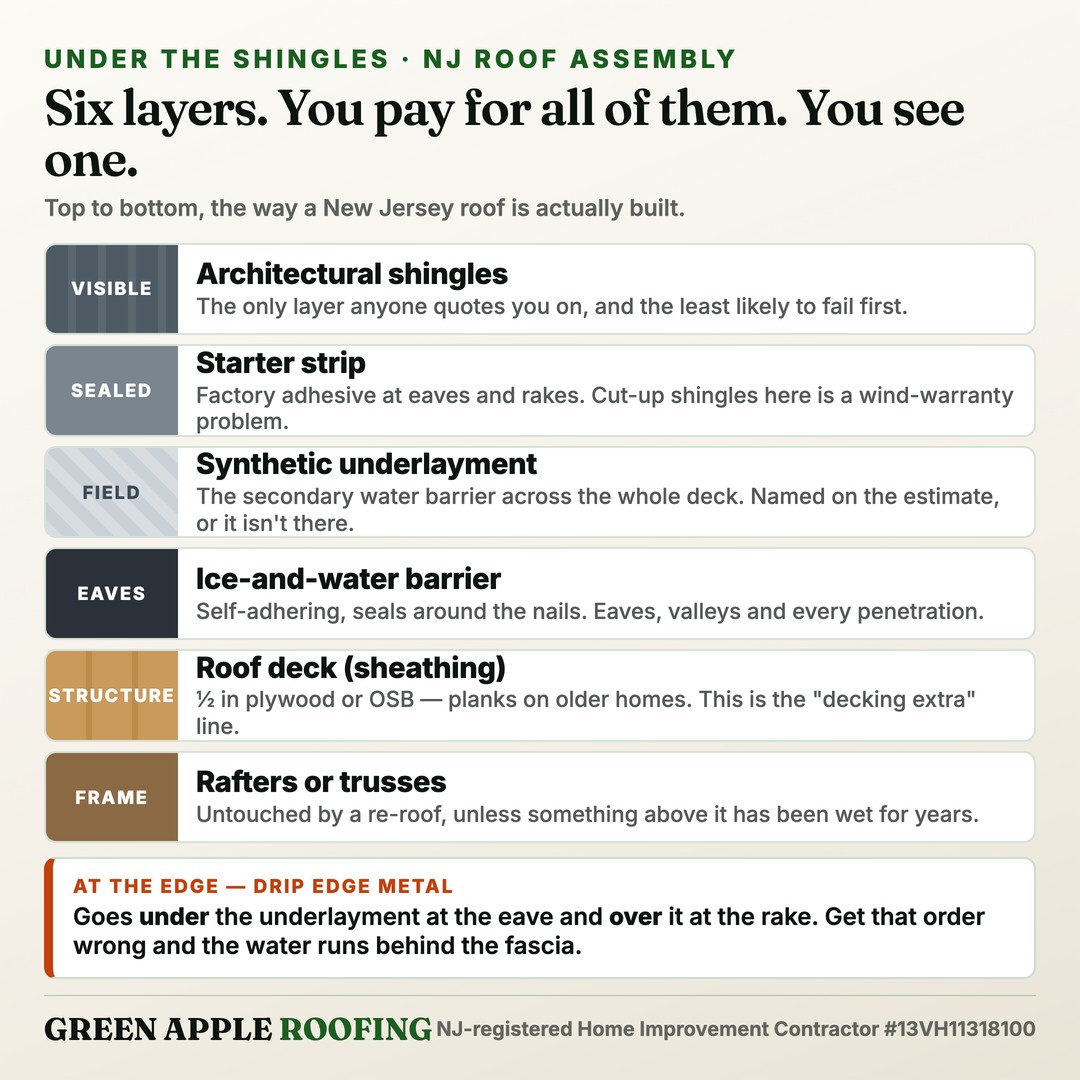
Under the shingles there are five more layers, and you are paying for all of them. From the top down: the starter strip that seals the first course, the synthetic underlayment that covers the whole deck as a secondary water barrier, a self-adhering ice-and-water barrier at the eaves, valleys and penetrations, the roof deck (sheathing) itself, and drip edge metal along the eaves and rakes. "Decking extra" shows up on a bill because nobody — honest or otherwise — can see the condition of the sheathing until the old roof is off. What separates a fair charge from a bad one is whether a price per sheet was agreed before the job started.
Green Apple Roofing is a licensed, bonded and insured New Jersey roofing contractor (NJ Lic. #13VH11318100) and a GAF Master Elite® contractor; we also install Owens Corning and CertainTeed systems.
The layers, top to bottom
The deck: what your whole roof is nailed to
The roof deck, or sheathing, is the structural skin over the rafters. On most New Jersey homes built since the 1970s it is ½-inch plywood or OSB. On older houses — and there are plenty around Monmouth and Ocean counties — it is wooden planks laid with gaps between them, which is fine structurally but a different proposition to nail into.
Decking fails in specific places rather than everywhere: around the chimney, in the valleys, along the eaves where ice dams have backed water up under the shingles, around old vents and skylight curbs, and anywhere a leak was patched from above for a few seasons. It also degrades from below, in an attic with no working ventilation, where warm moist air condenses on the underside of the deck all winter — one more reason attic ventilation shows up in every roofing conversation.
On a sound roof, expect none to a handful of sheets. On a roof that has been leaking, or one with two layers coming off, more. A crew that tells you the whole deck needs replacing before opening it up is guessing; a crew that finds nothing wrong on a roof that has leaked for three winters is not looking.
Why "decking extra" appears mid-job — and how to make it fair
It appears because it genuinely cannot be quoted in advance. That is not the scam. The scam is the version with no number attached: "decking replaced as needed" on the estimate, and a figure invented once your roof is open and you have no leverage. Four things turn it back into a fair line:
- A unit price per sheet, in writing, before work starts. Materials plus labor, one number, and it does not change on the day.
- Billed on what is used, not what was allowed. Some bids include an allowance of two or three sheets. Fine — as long as unused allowance comes off the invoice.
- Photographs of every sheet replaced, before it is covered. Dated, and sent to you. This is the one that ends the argument, and any decent contractor already does it.
- A call before it escalates. If a crew opens the roof and finds far more than expected, you should hear about it that morning, with photos, not on the final invoice.
That discipline is the same one that makes the whole estimate readable — see what a real NJ roofing estimate should include, where the decking line is one of five omissions worth catching before you sign.
Underlayment: felt vs synthetic
Underlayment is the layer over the whole deck that keeps water out if anything gets past the shingles — wind-driven rain, a lifted tab, the day between tear-off and shingles going down. Traditional asphalt-saturated felt still meets code. Synthetic underlayment is now the default on any decent job, and for good reasons: it is dramatically stronger, does not tear around fasteners, does not wrinkle when it gets wet, is far safer to walk on, and stays intact if the roof has to sit exposed overnight.
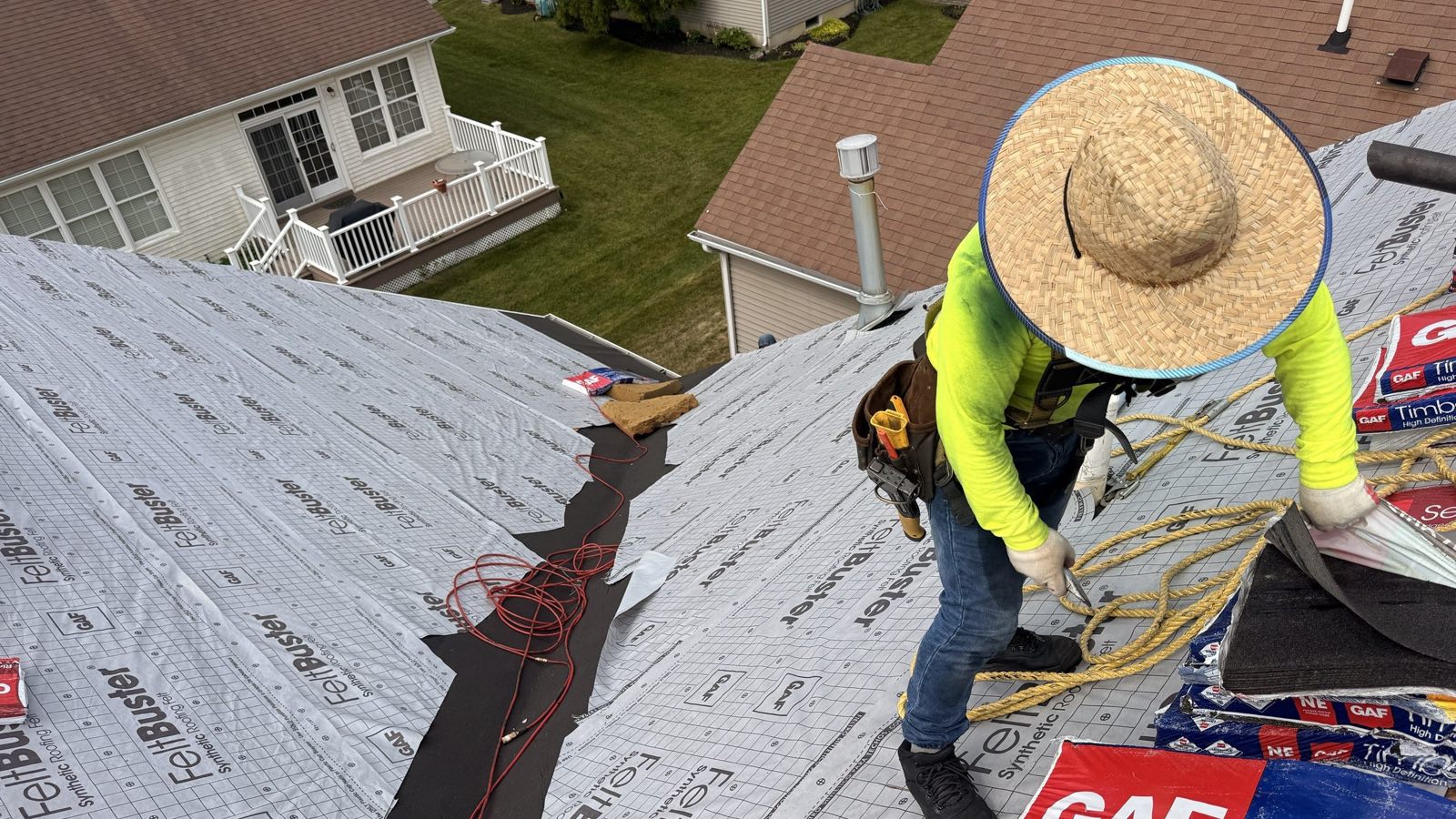
The cost difference across a whole roof is small. It is nonetheless a favorite quiet substitution on a low bid, which is why the estimate should name the product rather than say "underlayment." On our jobs it is a synthetic across the field, every time — the roof in the photograph above is covered in it.
Ice-and-water barrier: the layer that matters most in New Jersey
This is a self-adhering rubberized membrane that sticks directly to the deck and seals around every nail driven through it. It goes at the eaves (where meltwater backs up behind ice), in every valley (where two roof planes concentrate water), and around every penetration — chimneys, skylights, vents, pipes.
Two details are worth checking on a quote. First, how far up from the eave it runs: the requirement is that it extends past the interior face of the exterior wall, which on a house with deep overhangs means more than one course of membrane. Second, whether it is specified at all around penetrations, or only at the eaves. Both are cheap now and expensive later. The mechanics of what it defends against are in our ice dam guide.
Drip edge: the cheapest part of the roof, and one of the most-skipped
Drip edge is a bent metal strip that runs along the eaves and up the rakes. Its job is to carry water off the edge of the deck and into the gutter instead of letting it curl back under and run down the fascia. Without it, the edge of the sheathing stays damp, the fascia rots, and the gutter fills with debris washed off a soggy edge.
It is also one of the few places where order of installation is the whole point. At the eave, drip edge goes on the deck first and the underlayment laps over the top of it. At the rake, it goes on top of the underlayment. Reverse that and the metal channels water behind the fascia rather than in front of it — a mistake that looks identical from the ground for about two years. If the fascia or gutters are already showing rot, that is usually where it started.
Starter strip and ridge cap: the two ends of the roof
The starter strip is a purpose-made first course with factory adhesive, run along the eaves and up the rakes, that the first row of shingles seals down onto. The old trick of cutting up field shingles to use as starter leaves the sealant strip in the wrong place, which is exactly where wind gets under the roof. Manufacturers know this, which is why using their starter is generally a condition of the wind rating — and of the enhanced warranties covered in are roofing warranties worth it.
At the top, ridge cap shingles are thicker and pre-scored to bend over the ridge without cracking. Field shingles cut into three and bent over a ridge vent crack in the first cold snap. Both of these are small line items that a complete system quote includes and a stripped-down bid does not.
What this means when you compare two quotes
Two bids on the same house will usually name a similar shingle. The gap between them lives in this article: whether the underlayment is named, how far the ice-and-water runs, whether drip edge is on the list, whether starter and ridge are manufacturer products, and whether the decking line has a number on it. That is why the cheapest quote and the cheapest roof are rarely the same thing — and why the range in our roof replacement cost guide is a range rather than a price.
If you are still deciding whether you need a full replacement at all, start with the signs your roof is due; if you want to know how many years the current one has left, that is how long a roof lasts in NJ.
See what's under your roof before you buy a new one
We inspect the roof and the attic, tell you what condition the deck is likely to be in and why, and put the underlayment, the membrane run, the drip edge and a per-sheet decking price in writing before anyone starts. Free survey, no obligation, no upselling — and we beat or match any legitimate quote. Call (201) 681-0060 or book a survey. Recent work is in the project gallery.
Commercial roofing questions, answered.
Free commercial roof survey.
We'll survey your roof, tell you honestly whether it needs repair, recover, or replacement, and give you an itemized bid you can actually compare. Same-day phone response.