
Flat Roof Leaking? Emergency Response for NJ Buildings
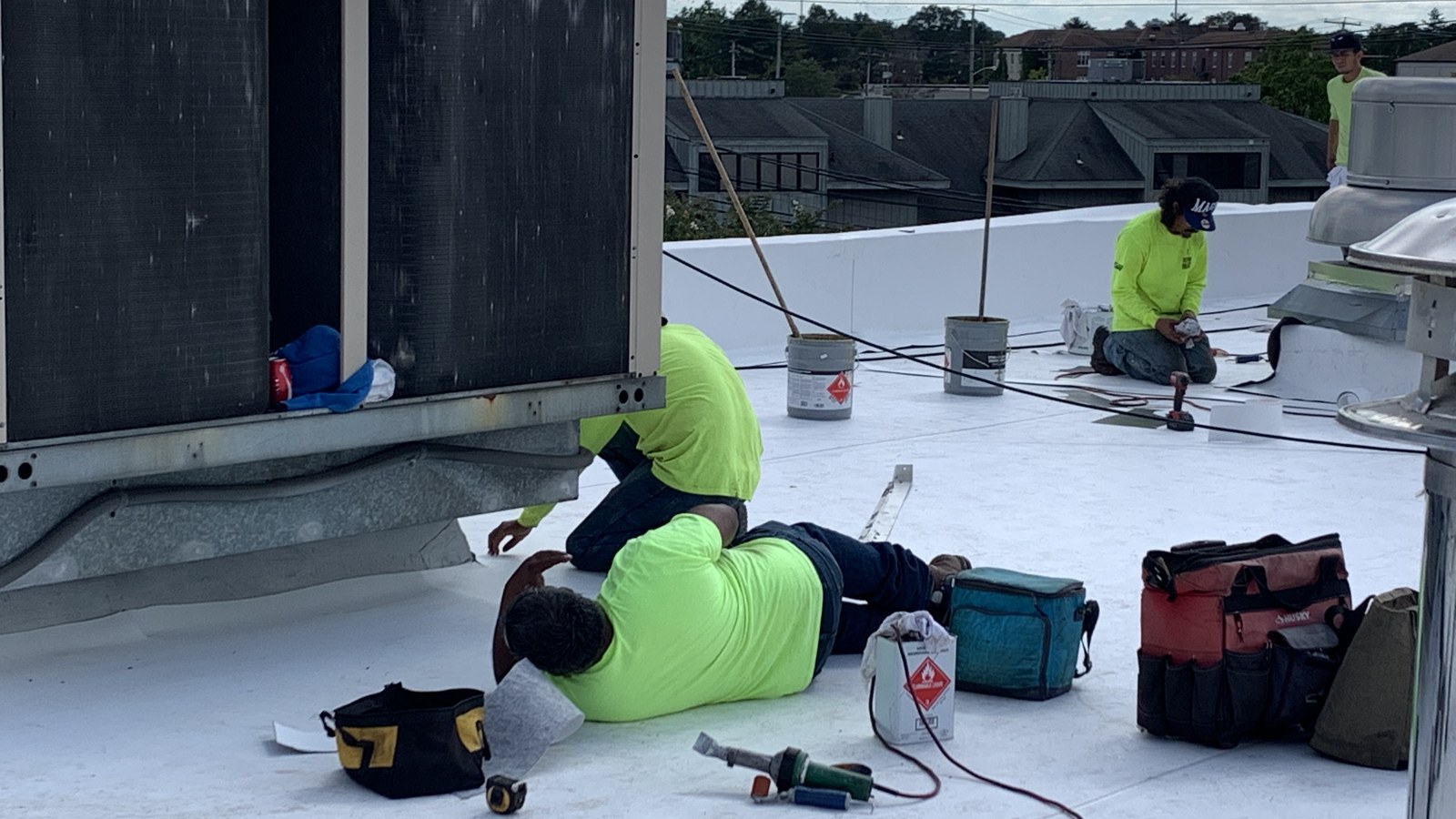
Protect what's underneath first, then find the leak. Move stock, equipment and electronics out of the way, put buckets down, and — if water is anywhere near lights or panels — kill the power to that area. Then call a roofer. What you should not do is go up on a wet flat roof yourself, and don't expect the hole to be above the drip: on a flat roof water enters at one point, travels sideways through the insulation, and comes through the deck somewhere else entirely. Emergency work is usually a two-step job — a temporary dry-in the same day to stop the water, then a permanent repair once the roof is dry enough to do properly.
Green Apple Roofing is an insured New Jersey roofing contractor (NJ-registered Home Improvement Contractor #13VH11318100) and a GAF GoldElite Commercial contractor. We respond to commercial leaks across Monmouth and Ocean counties.
The first hour: what to do before anyone gets there
- Cut the power to the affected area if water is near lighting, outlets or a panel. This is the one step that can't wait.
- Move what the water can ruin — inventory, files, servers, machinery. Cover what you can't move.
- Contain it. Buckets and bins under the active drips. If a ceiling tile is bulging with trapped water, put a bin under it and pierce it deliberately rather than letting it collapse across a room.
- Photograph everything, with timestamps. The ceiling, the floor, the damaged goods, the water coming in. If this becomes an insurance claim, these photos are the claim.
- Note the time and the weather. Whether it leaks only in driving rain, only in a long soak, or after snowmelt tells a roofer a great deal about where to look.
- Stay off the roof. A wet membrane is genuinely dangerous, and walking it in the wrong place makes the repair bigger.
Why the drip is never under the hole
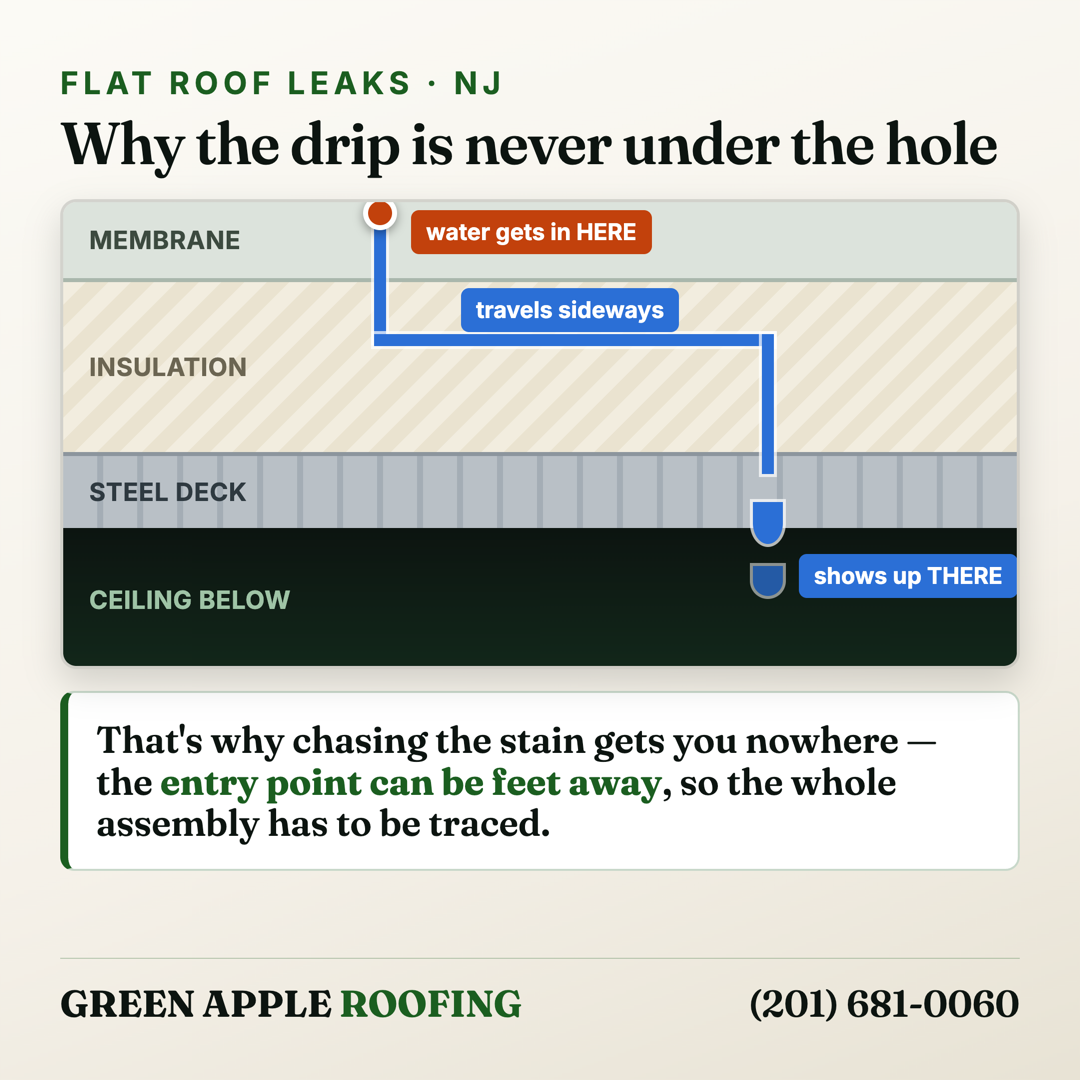
A flat roof is an assembly: membrane on top, insulation boards under it, then the structural deck. When water gets through the membrane, it doesn't fall straight down — it sits on the deck and runs along the seams and joints of the insulation until it finds a gap, a fastener, or a deck lap to fall through. The stain in your ceiling can be a long way from the actual breach. This is exactly why "I know where it's leaking" is rarely true, and why a repair aimed at the stain fails and then gets blamed on the roofer.
It's also why the entry point is usually a detail rather than the open field of the roof — a seam that has opened, flashing at a wall, a pitch pan that dried out, or a curb around a rooftop unit. Finding it means tracing the assembly back from the drip, not staring at the ceiling.
Temporary dry-in vs. permanent repair
On an active leak, a good contractor does two visits, not one. The temporary dry-in happens immediately: the area is cleared, water is pushed to a drain, and the breach is sealed with a patch or membrane target to stop water entering. It is not pretty and it is not the fix — it buys you a dry building.
The permanent repair waits until the assembly is dry, because sealing wet insulation under a new patch traps the water and rots the deck from the inside. On a soaked area we cut a test square or core to see how far the wet insulation runs; that wet board comes out and gets replaced before anything is closed up. Skipping that step is the single most common reason a "repaired" flat roof leaks again in the same place a season later. If the wet area turns out to be extensive, you're into a repair-or-replace decision rather than a patch.
What emergency roof repair costs in NJ
Emergency work costs more than scheduled work, and it's worth knowing why so the number isn't a surprise: a crew is pulled off another job, it's often after hours or in bad weather, and the diagnosis takes longer than the fix. A temporary dry-in on a commercial roof is typically a few hundred to low four figures depending on access and the size of the wet area; the permanent repair is quoted separately once the extent is known. Routine commercial roof repair booked in advance is materially cheaper than the same work at 9pm in the rain.
Two cost notes worth having in advance. First, get it in writing — even in an emergency, a scope and a number before work starts. Second, be wary of anyone who arrives at an emergency and immediately quotes a full replacement without opening anything up. A leak is a reason to check the contractor, not to skip checking them.
Does insurance cover it?
Generally, a commercial property policy covers sudden and accidental damage — and does not cover wear, age, or neglected maintenance. A membrane that failed because it reached end of life is a capital expense, not a claim. Damage to the contents and interior from a covered event is often the larger part of the payout. Your dated photos, the inspection reports in your file, and the emergency invoice are what turn a conversation into a paid claim. The residential version of that distinction is spelled out in does insurance cover a roof replacement, and the same wear-versus-event logic applies commercially.
How to stop being the building that floods
Nearly every emergency we attend was visible months earlier. Blocked drains and the ponding they cause, an open seam, a pitch pan that had dried and cracked, a curb someone stepped on during an HVAC service — all of them are ordinary findings on a routine walk. Two inspections a year plus a maintenance program is what turns a 9pm emergency into a scheduled Tuesday repair. On TPO and other single-ply systems the seams in particular reward being looked at before winter rather than after.
Leaking right now?
Call (201) 681-0060 — we respond to commercial leaks across Monmouth and Ocean counties, dry the building in first and quote the permanent repair in writing once we know the extent. No upselling, and we beat or match any reliable, legitimate roofing, siding or gutter quote. See our work in the project gallery or get in touch.
Commercial Roofing questions, answered.
Commercial Roofing
Ponding Water on a Flat Roof: When It's Normal and When It's a $40k Problem
ReadCommercial Roofing
Apartment & Multifamily Roof Replacement in NJ: What Property Managers Should Budget and Expect
ReadCommercial Roofing
Single-Ply Commercial Roofing: TPO vs EPDM vs PVC for Your NJ Building
ReadRequest a commercial roof survey.
We'll survey your roof, tell you honestly whether it needs repair, recover, or replacement, and give you an itemized bid you can actually compare. Same-day phone response.