
Ice Dams in NJ: Why They Form, What They Wreck, and How to Stop Them Before Winter
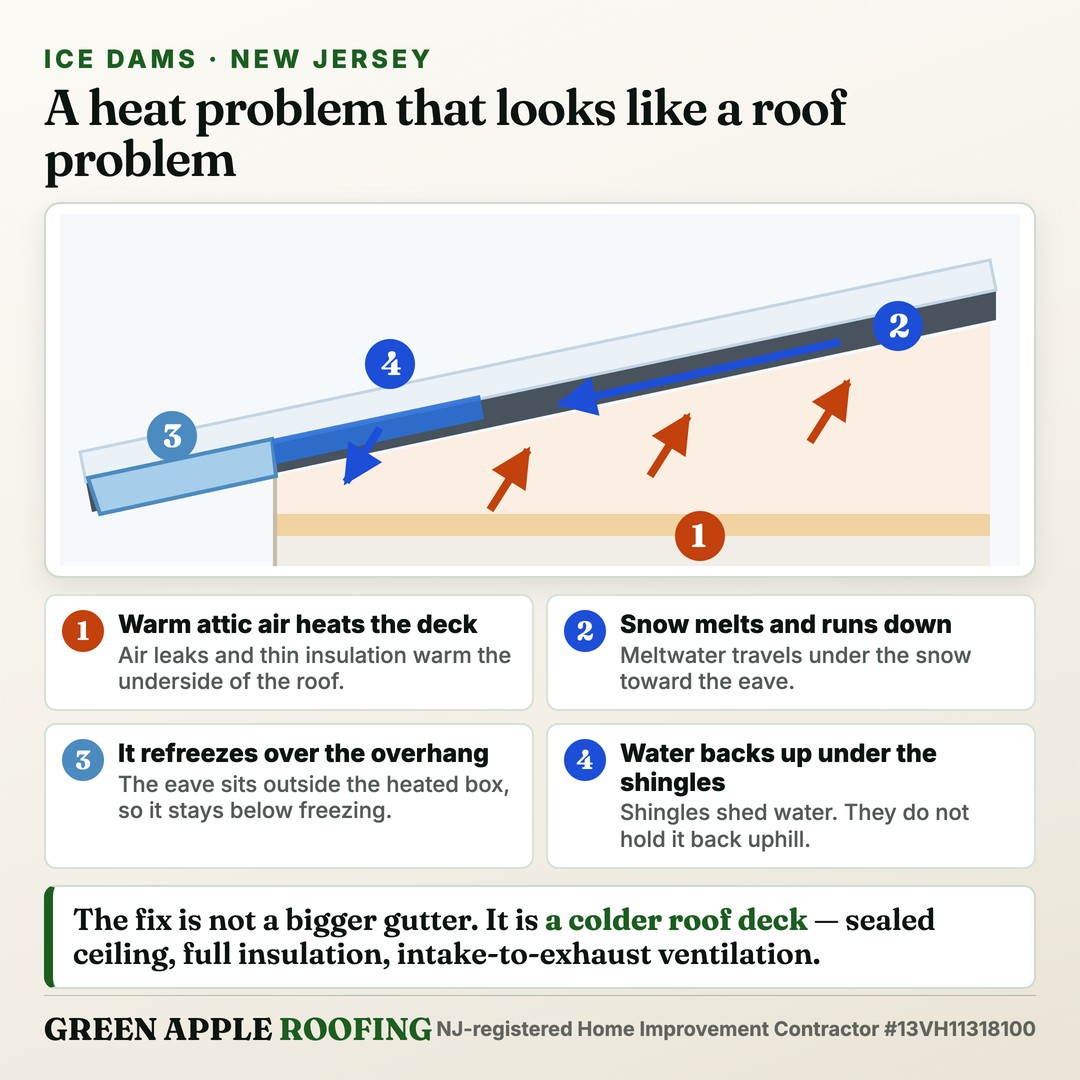
An ice dam is a ridge of ice at the edge of the roof that stops meltwater draining — so the water pools behind it and gets pushed back up under the shingles and into the house. It forms because heat escaping from the house warms the roof deck, melting the snow above the heated part of the roof; that water runs down to the eave, which sits outside the heated box and stays below freezing, and refreezes there. The cause is heat, not the roof. The fix, in order, is: air-seal the ceiling, bring the attic insulation up to depth, and balance intake-to-exhaust ventilation so the deck stays cold. Ice-and-water membrane at the eaves is the backup that limits the damage — it is not the prevention.
Green Apple Roofing is a licensed, bonded and insured New Jersey roofing contractor (NJ Lic. #13VH11318100), GAF Master Elite® certified and roofing the Jersey Shore since 2008. September is the month to deal with this — the work is straightforward in the fall and nearly impossible with ice on the roof.
What an ice dam actually is
Look at a house with an ice dam and you see icicles and a bar of ice along the gutter line. What is actually happening is a temperature split across one roof. The upper part of the roof — the part directly above the heated attic — is above freezing, so the snow on it melts from underneath. The last few feet of roof, the overhang beyond the exterior wall, has nothing warm under it and stays hard-frozen. Meltwater runs down the warm section, hits the cold section, and stops.
Once that first ridge of ice forms it becomes a dam, and every subsequent thaw adds to the pond of water behind it. Asphalt shingles are designed to shed water running down the roof; they are lapped, not sealed, so standing water simply finds its way between the courses and onto the deck. That is the moment the ceiling stain appears, usually along an outside wall.
Why New Jersey gets them despite the mild winters
Ice dams need repeated crossings of the freezing point far more than they need deep cold, which is exactly what a Monmouth or Ocean County winter delivers: a few inches of snow, daytime sun into the mid-thirties, and a hard freeze overnight. A Vermont roof that sits at 15°F for a fortnight often produces fewer dams than a Jersey Shore roof that swings across 32°F six times in a week.
The second factor is the housing stock. A great deal of New Jersey's residential building sits on attic insulation specified decades ago, with recessed lights, bath fans and attic hatches leaking warm air straight up. Add a ridge vent with no clear intake at the soffit and the attic has no way to flush that heat, so it lands on the deck. Every one of those is fixable, and none of them requires a new roof.
What an ice dam actually wrecks
- The ceiling and the wall below it. The classic sign is a stain where an outside wall meets the ceiling, appearing days after a thaw rather than during it.
- The insulation. Wet insulation compresses and stops performing, which makes the attic warmer, which makes the next ice dam worse. It is a loop.
- The roof deck. Repeated wetting of plywood or plank sheathing from above softens it. This is a large share of the "decking extra" that shows up on tear-off invoices years later.
- Gutters, fascia and soffit. Ice is heavy. A loaded gutter pulls on its fasteners and takes fascia board with it, which is why gutter and trim damage so often shows up alongside a leak.
- Air quality. Water in an insulated cavity that cannot dry is how mold starts, and it is usually discovered long after the stain was painted over.
The three fixes, in the order that actually works
1. Air-seal the ceiling (do this first)
Most attic heat does not conduct through the insulation — it leaks through holes in the ceiling plane. Recessed light housings, the attic hatch, bath and kitchen fan ducts, plumbing stacks, wiring penetrations and the top plates of interior walls. Sealing those is unglamorous, cheap relative to everything else, and it is the single highest-return step. Insulating over unsealed penetrations just filters the warm air on its way up.
2. Insulate to depth
Once the leaks are sealed, depth does the rest. Current energy code for this part of New Jersey lands attics in the R-49 to R-60 range depending on which code cycle your municipality is on — well above what a 1970s or 1980s house was built with. Just as important is the perimeter: insulation has to run out over the exterior wall's top plate without blocking the soffit intake, which is what baffles are for. Attics that were topped up by someone who stuffed the eaves solid are a common cause of the exact problem the insulation was meant to fix.
3. Balance the ventilation
Ventilation flushes whatever heat and moisture still reach the attic. It only works as a system — cool air in low at the soffit, warm air out high at the ridge — and the intake is the half that is usually missing or blocked. A ridge vent with no working intake pulls its air from inside the house through the ceiling leaks, which is worse than no vent at all. The full picture is in our guide to attic and roof ventilation, and it is the same system that decides how long your roof lasts.
The membrane at the eave: backup, not prevention
A self-adhering ice-and-water barrier along the eaves is standard on every roof we install, and code requires it in this climate. It seals around the nails and gives you a waterproof layer under the shingles for the first several feet up the slope, so if a dam does form, the water that backs up hits a membrane rather than bare deck. That is genuinely valuable — it converts a ceiling failure into a nuisance.
What it does not do is prevent the dam. Water still pools, still finds the gutter and fascia, still adds weight. And on a roof with a deep overhang, the standard run of membrane may not reach past the interior wall line, which is the point it needs to pass. If your roof is due anyway, ask for the membrane run to be specified by distance rather than "per code" — that is exactly the kind of line a real estimate spells out.
What doesn't work
- Chipping or hammering the ice off. You will take granules, shingles and sometimes the deck with it, and it is genuinely dangerous.
- Heat cables as a permanent answer. They can keep a channel open on a problem eave and they have a place as a stopgap, but they run on your electricity all winter and treat the symptom forever.
- Salt pucks and de-icer in the gutter. They corrode metal and stain what is below. Calcium chloride in a stocking laid across the dam is the least-bad emergency version, and it is still an emergency measure.
- Bigger gutters. Gutters have nothing to do with the cause. They fill with ice because a dam formed above them.
- A new roof on its own. New shingles over the same warm attic produce the same dam next winter, with a better membrane underneath it.
What to do in September
- Go into the attic on a cold morning and look for daylight, dark staining on the underside of the deck, or compressed insulation. Those three tell you most of what you need.
- Check the soffit vents from outside — and then check from inside whether insulation is sitting on top of them.
- Have the gutters cleared and the fasteners checked before the leaves finish falling. A gutter full of debris freezes solid first.
- Look at last winter's stains. A stain along an outside wall is the map of the problem.
- Get the roof looked at if you are unsure — a roof inspection that includes the attic will tell you whether this is a sealing job, a ventilation job, or a roof coming to the end of its life.
If it already leaked last winter
Damage from a previous winter is worth dealing with now rather than watching for again. Wet insulation should be pulled and replaced, not dried in place. Soft decking gets found and replaced when the roof is opened, not patched from below. Where the leak reached finishes, a homeowner's policy will often treat sudden water damage from an ice dam differently from long-term wear — the distinction is the same one explained in does insurance cover a roof replacement. And if the roof is showing its age anyway, weigh the signs it needs replacing against another season of targeted repairs.
Deal with it in September, not in February
We inspect the roof and the attic together — air leakage, insulation depth, intake and exhaust, eave membrane and gutter condition — and tell you honestly which of the three fixes your house actually needs. Free, no obligation, no upselling, and we beat or match any legitimate quote. Call (201) 681-0060 or book a survey. See our work in the project gallery.
Commercial roofing questions, answered.
Residential Roofing
Attic & Roof Ventilation: The System That Decides How Long Your NJ Roof Lasts
ReadResidential Roofing
Roof Leaking Only in Heavy Rain? What That Actually Tells a Roofer
ReadResidential Roofing
Under the Shingles: Roof Decking, Underlayment and Drip Edge — and Why 'Decking Extra' Shows Up on Your Bill
ReadFree commercial roof survey.
We'll survey your roof, tell you honestly whether it needs repair, recover, or replacement, and give you an itemized bid you can actually compare. Same-day phone response.