
Ponding Water on a Flat Roof: When It's Normal and When It's a $40k Problem
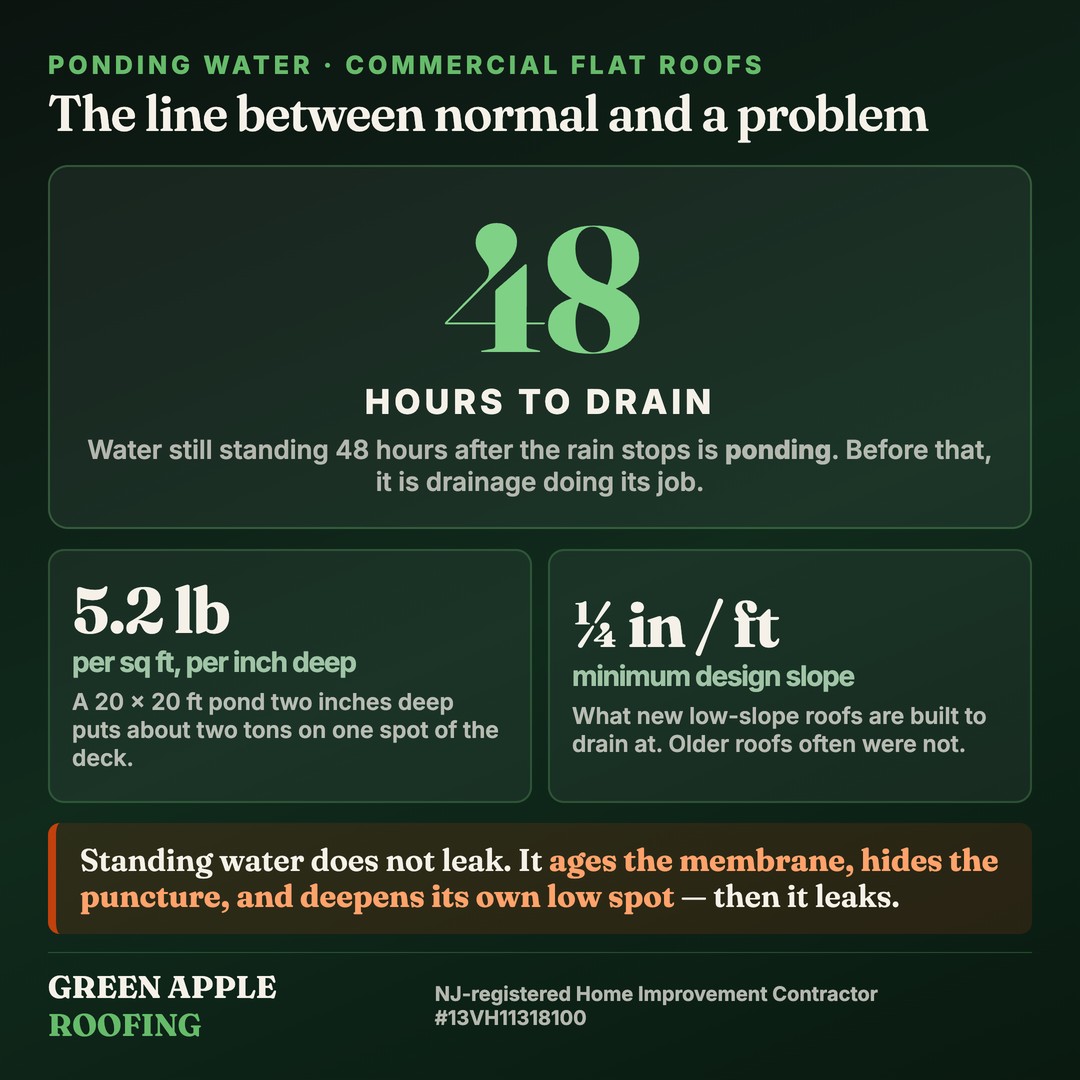
Water on a flat roof after rain is normal. Water still standing 48 hours after the rain stops is ponding, and it is not. That 48-hour line is the working definition the industry uses, and it is also the language in most manufacturer warranties — which typically exclude damage caused by ponding. The trap is that ponding does not leak on its own. It degrades the membrane, hides the puncture you would otherwise find, grows biological matter that holds more water, and slowly deepens its own low spot until the deck deflects. Then it leaks. Fixes run from clearing a drain for a few hundred dollars to a tapered insulation system over a section — and on a roof left long enough for the insulation to wet through, a full replacement.
Green Apple Roofing is a licensed, bonded and insured New Jersey roofing contractor (NJ Lic. #13VH11318100) and a GAF GoldElite™ Commercial contractor. We survey commercial flat roofs across Monmouth and Ocean counties and give you the finding in writing with photographs, whether or not it turns into work.
Is it ponding, or is it just draining slowly?
The test is time, not depth. A wide, shallow sheet of water two hours after a downpour is a roof doing its job. The same water two days later, on a dry, sunny stretch, is a roof that has stopped draining in that spot. Half an inch of standing water that clears by the following morning is far less of a problem than a shallow film that never leaves.
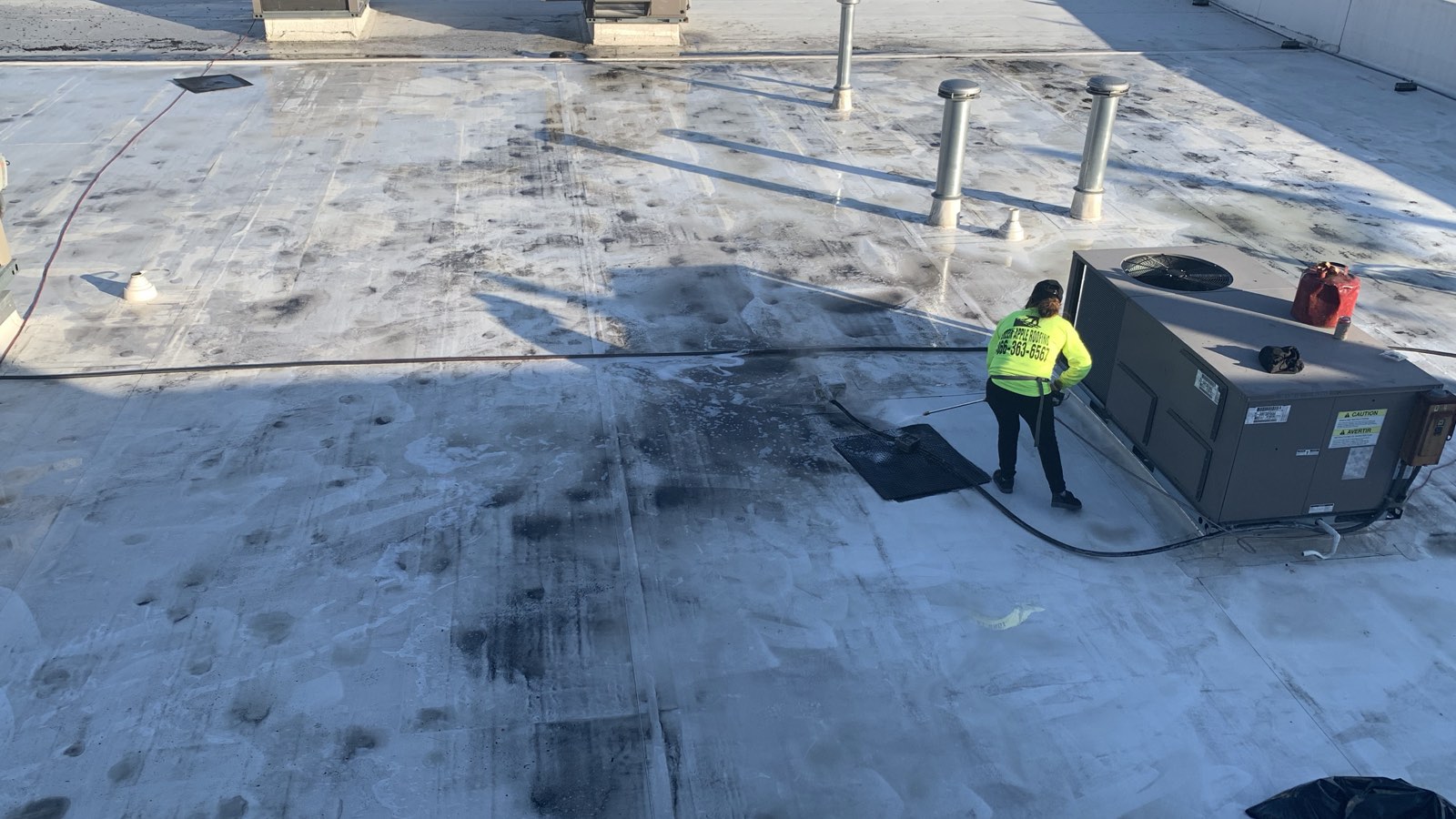
Checking it takes almost no effort. After the next real rain, note the time it stopped. Two days later, go up and look — photograph anything still wet, and mark the edge of each pond with a chalk line or a temporary marker. Come back after the following rain: if the same outlines fill in the same places, you have permanent low spots rather than a slow roof. And if it has not rained recently, the roof will tell you anyway — repeated standing water leaves dark staining and biological growth in exactly the shape of the pond, which is what you can see on the roof at the top of this page.
"My roofer said it's totally normal"
This is the sentence that sends building owners to the internet, and the honest answer is that it is half right. Some ponding is extremely common on existing low-slope roofs in New Jersey — plenty of buildings from the 1970s and 1980s were framed dead flat with drains placed for convenience rather than for drainage. A roofer who says "every roof around here does that" is describing reality accurately.
Common is not the same as acceptable, and it is definitely not the same as covered. Read the warranty on your membrane: most single-ply manufacturers explicitly exclude damage attributable to ponding water, and several make correcting it a condition of the warranty staying in force. So "normal" can be true and still leave you holding a roof whose warranty will not respond when it fails. The distinction between what a warranty says and what owners assume it says is the whole subject of are roofing warranties worth it.
What standing water actually does
- It ages the membrane in that spot faster than the rest of the roof. Constant saturation plus UV plus freeze-thaw cycling works on the sheet and, on lapped systems, on the seams within the pond.
- It hides the thing that will actually leak. A screw dropped by an HVAC tech, a small puncture, an open seam — all invisible under water, and all found immediately on a dry roof.
- It grows. Algae, then silt, then in real cases small plants. Organic matter holds water and blocks the last of the drainage, so the pond gets more permanent every season.
- It is heavy. Water weighs about 5.2 lb per square foot per inch of depth. A 20 × 20 ft pond two inches deep is roughly two tons sitting on one part of the deck.
- It voids your coverage. The most expensive consequence usually is not the water — it is discovering the exclusion in the warranty after the failure.
Why it gets worse by itself
Ponding is one of the few roof problems with a feedback loop in it. Weight causes the deck and the structure beneath to deflect very slightly. Deflection deepens the low spot. A deeper low spot holds more water, which is more weight, which is more deflection. On a steel deck over open web joists this is gradual and usually harmless for years; on a roof already carrying wet insulation, or one that has had rooftop equipment added since it was built, it is not something to leave to itself.
The same loop is why a pond that has existed for a decade is a different conversation from one that appeared last year. A new pond means something changed — a drain blocked, a unit was installed, insulation got wet and compressed. That is worth finding.
The five reasons it is there
| Cause | Tell | Typical fix |
|---|---|---|
| Blocked or undersized drains | Pond centered on or beside a drain | Clear, re-strainer, or add capacity |
| Deck deflection between joists | Long regular ponds parallel to the framing | Tapered insulation crickets |
| Wet or compressed insulation | Soft underfoot, pond deepening yearly | Core cut, then replace the wet area |
| Rooftop equipment added later | Pond upslope of a new curb or unit | Crickets to divert around the curb |
| Never had adequate slope | Wide flat ponds all over the field | Tapered system at the next replacement |
The first one is worth saying twice: a large share of the ponding we find in New Jersey is a drain problem, not a slope problem. Leaves, a collapsed strainer, or a drain line that has silted up will hold water on a roof that was built to drain perfectly well. That is a maintenance visit, not a capital project — and it is the reason a maintenance program pays for itself.
The fixes, cheapest first
- Clear the drainage. Drains, scuppers, strainers and the lines below them. Often the whole answer.
- Add capacity. A second drain, or a scupper through the parapet as an overflow, where the existing outlets cannot cope.
- Tapered crickets. Wedges of insulation that divert water around a curb or between drains. The standard fix for ponding caused by rooftop equipment, and a modest cost relative to anything structural.
- A tapered system over the affected area. Rebuild the slope across a section, then re-membrane over it. This is real money but far less than the whole roof.
- Replacement with a tapered design. When the insulation is wet across the field or the membrane is at the end of its life anyway, correcting the slope is done as part of the new roof.
So when is it actually a $40,000 problem?
When it is left long enough to wet the insulation. A pond over a puncture pushes water into the assembly; wet insulation loses its R-value, compresses, and creates a deeper low spot, and once the wet area covers a meaningful share of the roof there is no patch that fixes it. At New Jersey commercial pricing of roughly $7–$14 per square foot installed, a 4,000-square-foot roof replaced at $10 is $40,000 — a number that started as a blocked drain.
The decision point between a section repair and a full replacement is set by a core cut, not by opinion: cut the assembly open, see how far the wet insulation runs, and price from that. The framework is in repair, recover or replace, and if you are already at the replacement conversation, the membrane options are in our single-ply roofing guide.
What to do before the next rain
Walk the roof and clear every drain and scupper by hand. Photograph each pond outline with a date. Check whether anything has been added to the roof since the last survey — a new unit, a new conduit run, a satellite mount — because added equipment is behind a large share of new ponds. If any pond feels soft underfoot or the membrane looks wrinkled around it, stop and get a proper inspection with core cuts rather than guessing. And if it is already coming through the ceiling, the sequence is different — see what to do when a flat roof is actively leaking, then book the permanent repair once the assembly is dry.
Get the ponding mapped before it becomes a capital project
We survey the roof, map every pond, check the drains and cut cores where the assembly feels wet — then give you a written report with photographs and the cheapest fix that actually works. Free survey, no obligation, no upselling, and we beat or match any legitimate quote. Call (201) 681-0060 or get in touch. Recent commercial work is in the project gallery.
Commercial roofing questions, answered.
Free commercial roof survey.
We'll survey your roof, tell you honestly whether it needs repair, recover, or replacement, and give you an itemized bid you can actually compare. Same-day phone response.