
Chimney Flashing Repair: Why Chimneys Leak on NJ Roofs and What to Ask a Roofer
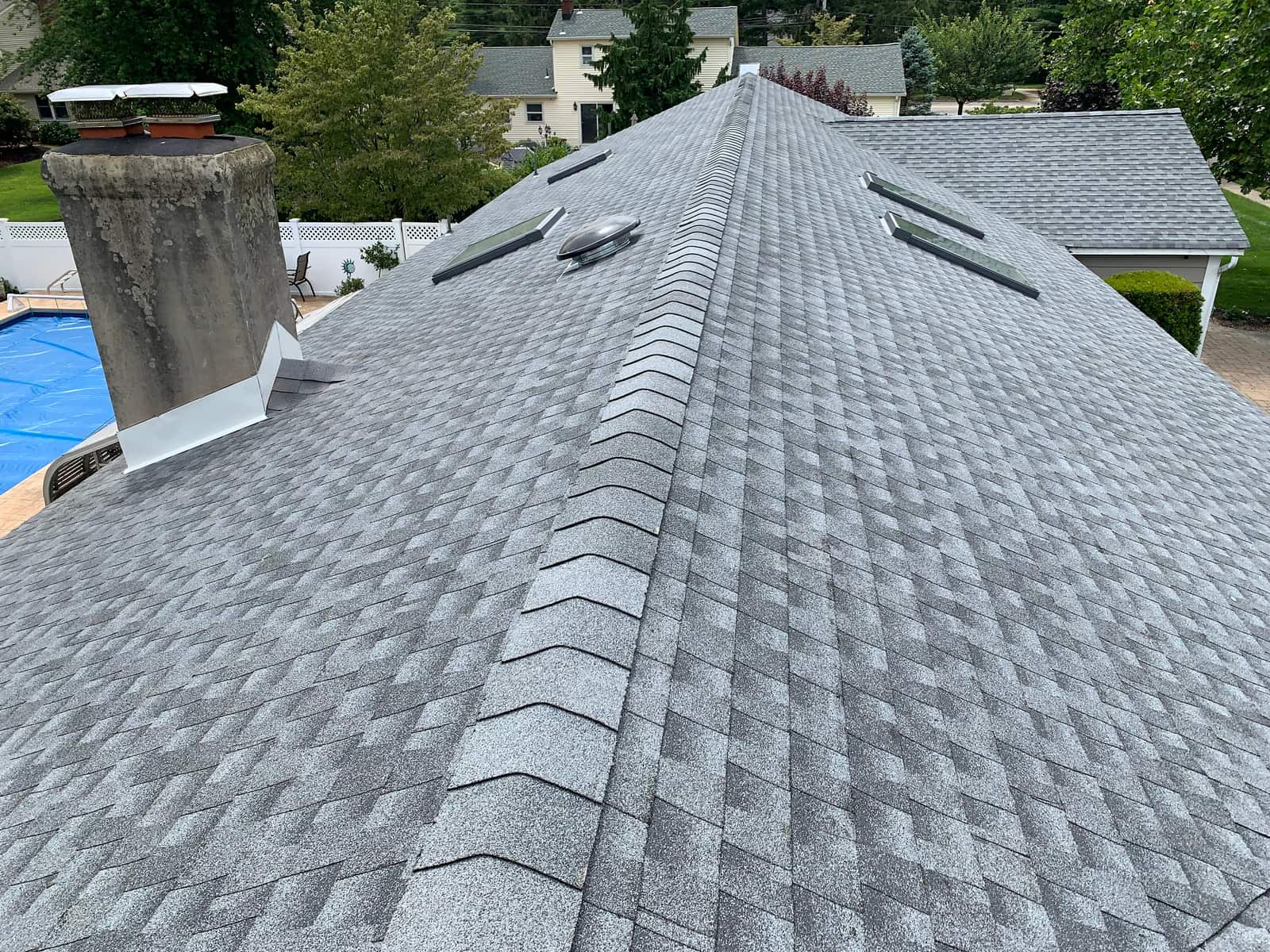
Chimney flashing means the metal pieces that seal the joint between a chimney and the roof, and a chimney leaks when water gets past one of them. Step flashing runs up the sides with the shingles, counter flashing covers it from the brick, and a back pan or saddle handles the uphill face. In chimney flashing repair, where the water shows up tells a roofer which piece to check.
Green Apple Roofing has been in business since 2008. Our office is in Ocean Township, and we serve Monmouth and Ocean counties, including Toms River and Middletown, and all of New Jersey. We are an NJ-registered Home Improvement Contractor (#13VH11318100), insured, and a GAF Master Elite® contractor. This is the detailed companion to what a roof that leaks only in heavy rain tells a roofer, where chimney flashing is the first suspect on the list.
The four pieces of metal around a chimney
A chimney is a box of masonry standing up through a sloped roof, and water meets it on all four sides. Each side has its own piece:
- Apron flashing on the downhill face: a bent piece that laps over the shingles below the chimney and turns up the brick.
- Step flashing up both sides: short L-shaped pieces installed with each shingle course, so water running down beside the chimney is carried on down the slope.
- A back pan or a saddle on the uphill face, where water running down the roof meets the chimney head-on. A saddle (also called a cricket) is a small ridged roof that splits the flow around the chimney. The residential code requires a cricket (saddle) on the uphill side of any chimney more than 30 inches wide, measured across the slope. It must be covered with sheet metal or the same material as the roof.
- Counter flashing on the chimney itself: metal attached to the masonry that laps down over the top edge of the apron, the steps and the back pan, covering the joint between the roof's flashing and the brick.
The first three work with the roof. The fourth works with the chimney. A leak at the chimney means water has found a way past one of the four, or is coming through the chimney itself.

Step flashing vs counter flashing
| Step flashing | Counter flashing | |
|---|---|---|
| Where it sits | Along the sides, installed with the shingles | On the chimney, over the top of the step flashing |
| What it does | Carries water down the slope past the chimney | Covers the top edge of the step flashing against the brick |
| Works with | The roof | The chimney |
The two work as a pair. If either one is damaged, loose or missing, water can reach the roof deck beside the chimney, and from there the ceiling or wall below.
What the code says about chimney flashing
As of October 2026, New Jersey's residential code is the 2024 International Residential Code: New Jersey adopted the 2024 International Residential Code effective August 17, 2026, with a six-month grace period. Code requires flashing wherever a roof meets a wall, wherever the slope or direction changes, and around roof openings. Metal flashing must be corrosion-resistant and at least 0.019 inch thick (26-gauge galvanized).
For chimney flashing on a shingle roof, the code points to the shingle manufacturer's instructions. In the code's words, chimney flashing "shall be applied in accordance with the asphalt shingle manufacturer's instructions." So the useful question about any chimney is not whether it looks like a neighbor's, but whether its flashing was installed to the instructions for the shingle on that roof. The cricket rule above applies to chimneys more than 30 inches wide. This is general information, not legal advice; your local construction office has the final word.
How a chimney leak shows up, and whose work it is
Water that shows up around a chimney does not always come in at the roofline. It can enter at the top of the chimney and run down inside. Separate the two before anyone starts work:
| What you see | Where to look first | Whose work it is |
|---|---|---|
| Damp in the attic beside the chimney, worst in wind-driven rain | Apron, step flashing, back pan or counter flashing | Roofer |
| A ceiling or wall stain next to the chimney | The flashing on the side nearest the stain | Roofer |
| Water at the fireplace or in the firebox | Crown or flue cap | Mason or chimney company |
| Rust streaks down a sided chimney, water inside the chase | Chase cover | Chimney company or sheet-metal shop |
| Damp on the inside face of the brick, white powder outside | The brick and mortar joints | Mason |
The crown is the concrete or mortar cap on top of a masonry chimney. The chase cover is the metal top on a framed chimney, the boxed-in, sided kind built around a factory-made fireplace flue. Neither is part of the roof. When the water is coming in up there, work on the flashing will not stop it, and the right call is the trade that fixes the top of the chimney.
What to ask a roofer about chimney flashing repair
- Which piece is letting water in? Ask for photographs of the apron, both sides, the uphill face and the counter flashing, and which one the roofer thinks is the cause.
- Is it the flashing or the chimney? Ask whether the water could be coming from the crown, flue cap, chase cover or brick instead, and whose work that would be.
- Does the chimney need a cricket? If it is more than 30 inches wide, ask about the cricket (saddle) on the uphill side.
- What metal will be used? Code calls for corrosion-resistant metal at least 0.019 inch thick.
- Which instructions will it be installed to? For a shingle roof, ask which shingle manufacturer's instructions the chimney flashing will follow.
- What did you find underneath? If shingles come off at the base of the chimney, ask for photographs of the roof deck there before it is covered again.
Re-flashing a chimney is roof repair work. What the water has reached by the time it is found, such as the deck at the base of the chimney, changes the scope of the job.
If you are replacing the roof anyway
A roof replacement is the natural time to deal with chimney flashing, because step flashing is installed with the shingles. Ask whether the existing chimney flashing will be replaced or reused, and look for it on the quote as its own line. If it is not there, that is one of the gaps covered in what a real NJ roofing estimate should include.
Permits for chimney and roof work in NJ
As of October 2026, the rule reads this way. Since March 5, 2018, New Jersey treats the repair or replacement of the roof covering on a detached one- or two-family home as ordinary maintenance: no construction permit or inspection is required, but the work must still meet code. Sources: the state's ordinary maintenance notice and N.J.A.C. 5:23-2.7.
Townhouses, multi-family and commercial roofs, and any work that affects the structure, still go through the permit process. Rebuilding a chimney is not on New Jersey's list of permit-free 'ordinary maintenance' work. The only chimney item on that list is applying a liquid lining inside an existing chimney. Ask your local construction office before a rebuild. This is general information, not legal advice; your local construction office has the final word.
When to have it looked at
Nor'easters hit New Jersey most often between October and April; the State Climatologist notes that rarely does a winter go by without at least one significant coastal storm. A chimney that leaks in heavy rain now will be tested again before spring. The chimney is one of the things to check in a proper roof inspection.
Tell us where the stain is
Tell us where the water shows and when it shows up. Same-day estimates by phone. We'll beat or match any reliable, legitimate roofing, siding or gutter quote. Veteran and first-responder discount — mention it when you book. Call (201) 681-0060 or get in touch.
Residential Roofing questions, answered.
Request a commercial roof survey.
We'll survey your roof, tell you honestly whether it needs repair, recover, or replacement, and give you an itemized bid you can actually compare. Same-day phone response.