
Commercial Roof Inspection: What NJ Building Owners Should Check
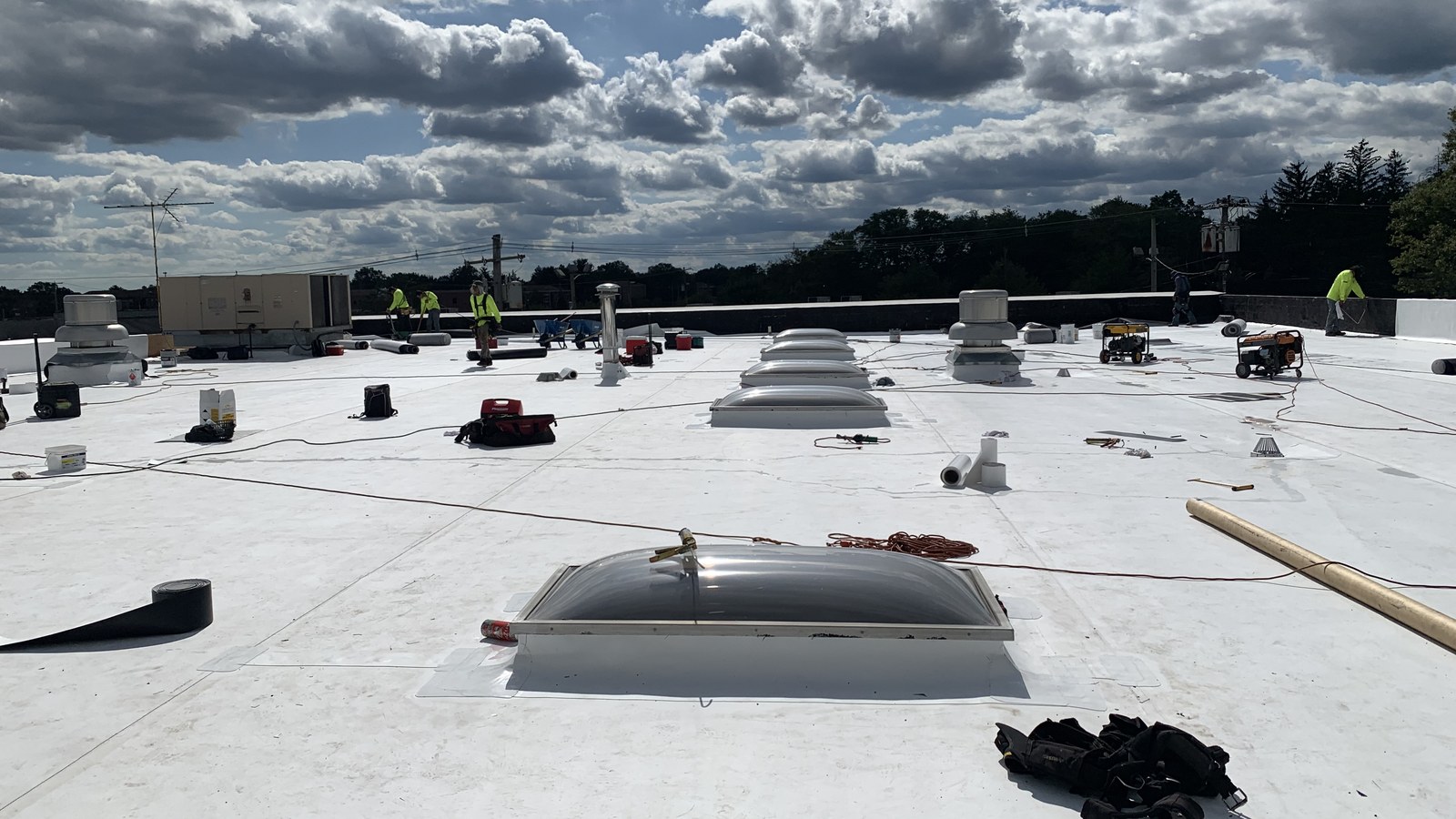
A commercial roof inspection is a documented walk of the roof surface, every penetration through it, and the ceiling directly below it. The standard for a NJ building is twice a year — once in spring, once in fall — plus a look after any major weather event. A proper inspection covers five zones: drains and ponding, seams and welds, flashing and parapet, curbs and penetrations, and skylights. Nearly every commercial leak we're called out to starts in one of them. The point isn't the walk — it's catching a seam repair while it still costs a few hundred dollars, instead of after water has been sitting in the insulation and the deck for two years.
Green Apple Roofing is a licensed, bonded, and insured New Jersey roofing contractor (NJ Lic. #13VH11318100) and a GAF Master Elite and GoldElite Commercial contractor. Inspections are free and come with no obligation — including a written report you keep whether or not you hire us. For a portfolio, that report is what a phasing plan gets built on: see multifamily roof replacement.
The five zones a commercial roof inspection covers
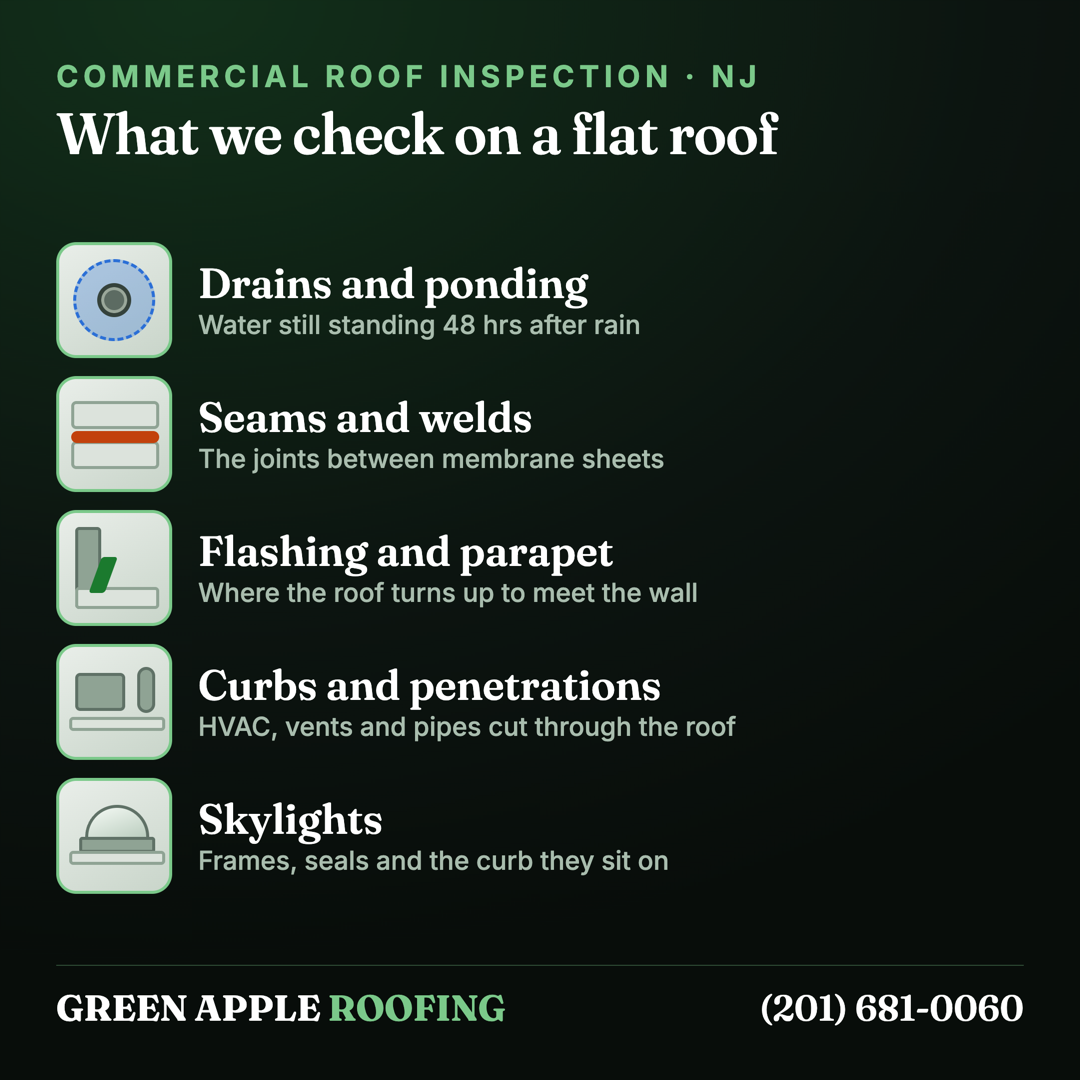
- Drains and ponding. Drains get blocked by leaves, gravel and debris. The test is simple: if water is still standing 48 hours after rain, that's ponding, and it's a problem — it adds dead load, it accelerates membrane wear, and on most manufacturer warranties it's grounds for a denied claim.
- Seams and welds. A single-ply roof is sheets of membrane joined together, so the joints are the weak line. On a TPO roof the seams are heat-welded; on EPDM they're adhesive or tape. We probe them — a seam that opens under a probe is a leak that hasn't happened yet. (More on how the two membranes differ: TPO vs EPDM.)
- Flashing and parapet. Where the roof turns up to meet a wall is the single most common failure point on a flat roof. We check the base flashing, the termination bar, and the coping on top of the parapet.
- Curbs and penetrations. Every HVAC unit, vent, pipe and conduit is a hole cut in a waterproof surface and then sealed back up. Pitch pans dry out, sealant cracks, and units get serviced by people walking on the membrane in the process.
- Skylights. The frame, the seals and the curb the skylight sits on. Old units and dried seals are a routine source of drips that get blamed on the roof field. (For homes: skylights in NJ.)
How often should a commercial roof be inspected?
Twice a year — spring and fall — plus after any major weather event. The two seasonal passes exist for different reasons. The spring inspection finds what New Jersey's freeze-thaw winter did: water that got into a small opening, froze, expanded it, and thawed again, over and over. The fall inspection is about getting the drains clear and the details tight before that winter starts. Skipping the fall one is the more expensive mistake.
Two other triggers are worth putting on the calendar: before your warranty anniversary (many manufacturer warranties expect documented maintenance and can be voided without it), and after any rooftop work by another trade — HVAC service, solar, satellite, sign installers. Someone who is not a roofer walking your membrane with tools is one of the most reliable ways to get a new leak. A standing maintenance program folds all of this into a schedule so it isn't left to memory.
What a building owner can check without going on the roof
You should not be walking your own roof — the fall risk is real and on a warm day you can damage a membrane just by walking it wrong. But there is plenty you can catch from inside the building and from the ground:
- Ceiling tiles and stains. Brown rings, sagging tiles, or a tile that's been quietly swapped out by a maintenance tech. Note where — the leak is often not directly above the stain.
- Damp or musty smell in a warehouse or back-of-house area, especially after rain.
- Rust on the deck, joists or fasteners visible from below. Rust means water has been arriving for a while.
- Downspouts that run dry in a downpour — if the roof is draining but the downspout isn't, the water is going somewhere else.
- Debris and vegetation visible at the roof edge or in the gutters from the ground.
- Interior tenant complaints — in a multi-tenant building these are your early-warning system, and they usually arrive before anything is visible.
What you should get in writing
The walk is half of it. An inspection that ends in a verbal "looks alright" is worth nothing to you six months later, and nothing to a warranty claim. A real report gives you:
- Dated photos of every problem area, so you can see what we saw and compare it to next visit's photos.
- Location, not just a list — findings marked on a roof plan so a repair crew can be sent to the right place.
- A severity split: fix now, watch, and fine. Everything is not urgent, and a contractor who says it is should be a warning to you.
- A repair-or-replace read with numbers. If the roof is near end of life, you need a budget figure to plan against — see repair vs. replace and commercial flat roof replacement cost in NJ.
- Remaining service life, so you know whether you're budgeting for next year or year six.
Keep the reports. A file of dated inspections is what supports a manufacturer warranty claim, what a buyer's engineer asks for in a sale, and what stops a roof from becoming an emergency capital request in the middle of a fiscal year.
What happens after the inspection
Most inspections end in one of three places. Nothing needed — clear the drains, note the date, come back in six months. Targeted repair — a seam, a pitch pan, a length of flashing, handled as commercial roof repair for a fraction of a replacement. Or the roof is at end of life, the repairs have stopped holding, and you're better served putting the money toward a new system than into another year of patches. If instead the roof is already leaking, that's a different job with a different order of operations — see flat roof leaks and emergency response. An honest inspector will tell you which of the three you're in, and will be willing to say "nothing needed" — that answer is the one that earns the next call.
If you're getting bids off the back of an inspection, get more than one, and check the contractor before you check the price: how to choose a commercial roofing contractor in NJ. Managing a home rather than a building? The residential version is here: do you need a roof inspection?
Have a commercial roof that hasn't been looked at this year?
We'll walk it and send you a written, photographed report with a repair-or-replace read and a remaining-life estimate — free, with no obligation and no upselling. We're a GAF GoldElite Commercial contractor, veteran-owned, and we beat or match any legitimate quote. See our work in the project gallery or schedule an inspection.
Commercial roofing questions, answered.
Commercial Roofing
Ponding Water on a Flat Roof: When It's Normal and When It's a $40k Problem
ReadCommercial Roofing
Apartment & Multifamily Roof Replacement in NJ: What Property Managers Should Budget and Expect
ReadCommercial Roofing
Single-Ply Commercial Roofing: TPO vs EPDM vs PVC for Your NJ Building
ReadFree commercial roof survey.
We'll survey your roof, tell you honestly whether it needs repair, recover, or replacement, and give you an itemized bid you can actually compare. Same-day phone response.