
How a TPO Roof Goes On: What the Crew Does From Tear-Off to the Last Seam
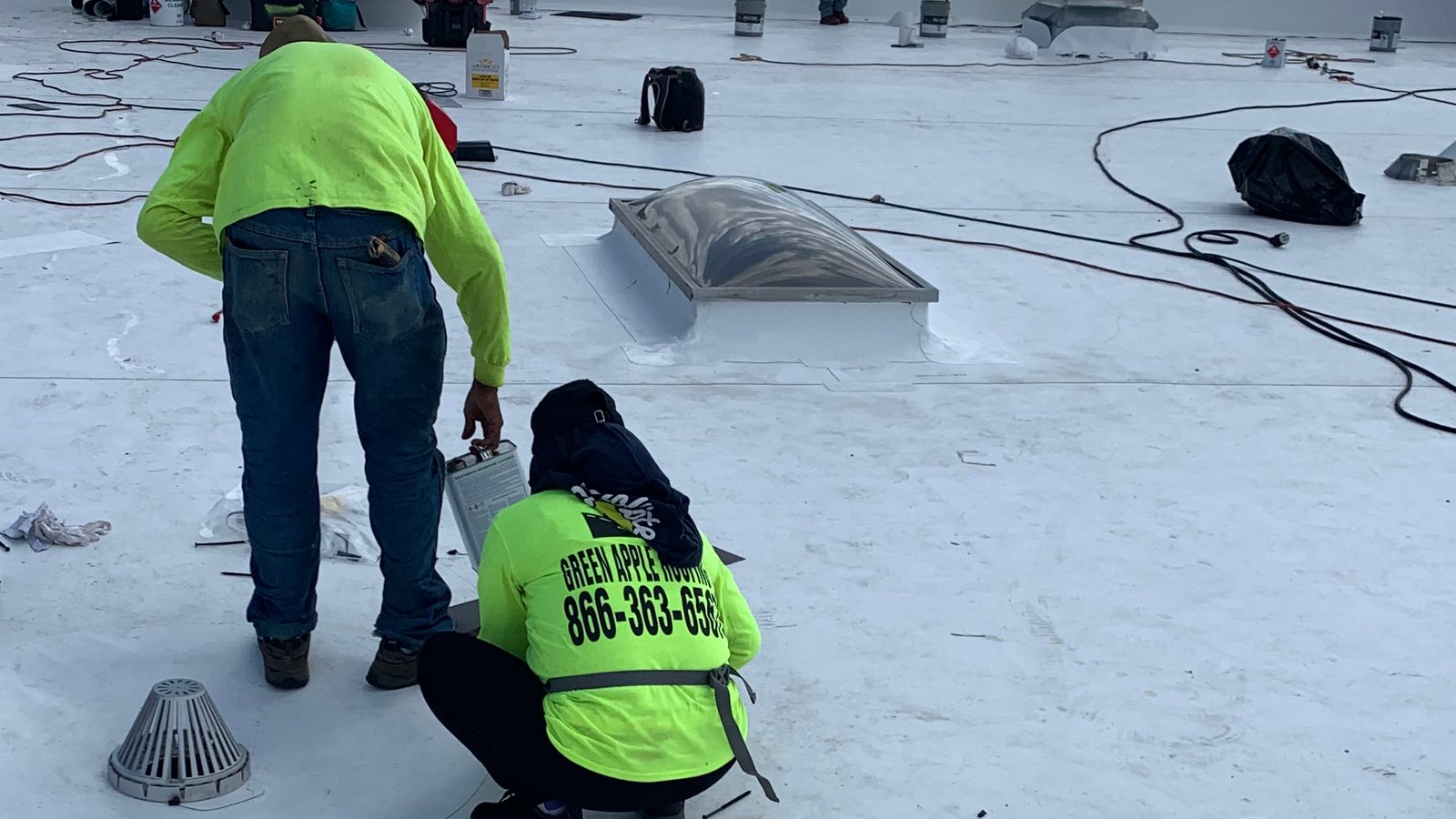
Short answer. A TPO roof goes on in seven stages: tear-off or recover prep, deck repair, insulation and cover board, attaching the membrane, hot-air welding every seam, flashing walls, edges and penetrations, and probing every seam before close-out. The open field goes quickly. The detail work at walls, drains and rooftop units takes the most time and matters most.
1. Survey and plan
Before any material arrives, the roofer walks the roof, cores it to see what is underneath, checks drains and slope, and notes every penetration and rooftop unit. That survey decides whether the old roof comes off (tear-off) or a new membrane can go over it (recover), what insulation is needed, and how the membrane will be attached.
2. Tear-off and deck repair
On a tear-off, the old membrane and wet or damaged insulation are removed down to the deck, usually in sections so the building is never left open to weather overnight. With the deck exposed, the crew replaces rusted metal deck, rotted wood or damaged concrete patches. Deck repair is often the line item that changes the price, because nobody can see it until the old roof is off. See commercial flat roof replacement cost in NJ.
3. Insulation and cover board
Rigid insulation boards (commonly polyiso) go down next, often in two layers with staggered joints so there is no straight path for heat or air. Tapered insulation can be used to build slope toward drains where the deck is flat. A thin cover board on top protects the insulation from foot traffic and gives the membrane a smooth, firm base.
4. Attaching the membrane
TPO is usually attached one of three ways:
| Method | How it works | Often chosen when |
|---|---|---|
| Mechanically attached | Plates and fasteners through the membrane edge into the deck, covered by the next sheet's overlap | Steel or wood decks, cost-sensitive jobs |
| Fully adhered | Bonding adhesive across the whole sheet | Higher wind exposure, smoother finish, less flutter |
| Induction welded | Plates fastened first, membrane bonded to the plates with an induction tool | Fewer penetrations through the sheet |
The manufacturer's specification and the building's wind zone decide which method and fastener pattern is used. That is also what the warranty is written against.
5. Heat-welding the seams
This is the step that makes TPO what it is. Where sheets overlap, a hot-air welder melts the two layers together into one piece of plastic. Large automatic welders run the long field seams; handheld welders and rollers do the corners and details. A good weld is continuous and uniform along its full length. What the edge of a finished seam should look like is not the same for every membrane: inspection guidance for TPO differs from guidance for PVC, so the crew and any inspector judge seams against the specific membrane manufacturer's installation manual, not a general rule of thumb.
6. Flashing walls, edges and penetrations
- Parapet walls: membrane runs up the wall and is secured with a termination bar or under coping.
- Roof edges: edge metal and gutters are installed and flashed into the membrane.
- Drains: the membrane is clamped into the drain bowl.
- Pipes, vents and conduit: pre-formed boots or field-fabricated flashing, all welded.
- Rooftop unit curbs: wrapped and welded, one of the most important details on the roof.
Most leaks on a new single-ply roof come from details, not the field. See where a flat roof drains.
7. Probe, clean up and close out
The crew checks every seam with a probe (a blunt tool run along the edge of the weld) to find any gap, and re-welds anything that catches. Debris and fasteners are removed from the roof and the grounds. The manufacturer may send its own inspector before issuing a warranty. See commercial roof warranties.
Before the first sheet goes down: specification and permit
A commercial roof is built to a written specification: the membrane thickness, the insulation type and thickness, the attachment method and fastener pattern, and the details at every edge, wall and penetration. That specification comes from the manufacturer and the building's needs (wind exposure, energy code, interior use). The warranty is written against it, so substitutions on the roof can cost the owner the warranty later.
Most commercial roof replacements need a permit from the local construction office. The roofer usually pulls it, and the town inspects at the end.
Safety on the roof
Commercial roof work is done at height, often with hot-air welders, power fasteners and heavy material lifts. Expect to see:
- A controlled access point and a material hoist or lift.
- Warning lines or guardrails set back from the roof edge, and fall protection where required.
- Protection around open skylights and roof hatches.
- A clear zone below where material is lifted or debris comes down.
As the owner, keep staff and tenants off the roof while work is in progress, and agree on who the crew contacts if something inside the building needs attention.
Recover or tear-off, in brief
Not every TPO job starts with a full tear-off. If the existing roof is dry and sound and the building code allows another layer, a new membrane can sometimes go over it with a new layer of insulation or cover board. A core survey and, often, a moisture scan decide whether that is safe. Wet insulation left under a new roof keeps rotting the deck and makes the new roof fail early, so the survey matters more than the savings.
How to tell the job was done well
- Seams are continuous, match the membrane manufacturer's inspection guidance for that product, and pass the probe test.
- The membrane runs up walls to the specified height and is secured at the top.
- Drains are clamped and the membrane lies flat into them.
- Flashing around every unit curb and penetration is welded, not just sealed.
- The roof is clean of debris and fasteners at the end.
- You have the permit sign-off, the specification and the warranty paperwork.
What a building owner should expect
- Access: a staging area for materials and a dumpster, and a lift or crane on delivery days.
- Noise: tear-off and fastening are loud; ask for the schedule.
- Weather: work stops for rain, and some adhesives need minimum temperatures.
- Tenants: a short notice to occupants before work starts.
- Paperwork: the permit, the manufacturer's specification and the warranty registration.
The parts list on a TPO bid
A commercial roofing bid names parts a building owner rarely sees. On a TPO job, expect lines like these:
- Membrane thickness, stated in mils (thousandths of an inch). Common thicknesses are 45, 60 and 80 mil; a thicker sheet costs more and carries more material above the reinforcing scrim.
- Insulation type and R-value, and whether tapered insulation is included to build slope to the drains.
- Cover board, its type and thickness.
- Attachment method and fastener pattern, taken from the manufacturer's specification for the building's wind exposure.
- Termination bar, coping and edge metal, with the gauge or finish of the metal.
- Curb and penetration flashings, counted, because each one is detail work.
- Walkway pads to the rooftop units, which protect the membrane where technicians walk.
- Warranty type and length, and whether the manufacturer inspects before issuing it.
If two bids differ a lot, compare these lines one by one before comparing totals. A lower price can mean a thinner membrane, less insulation or details left out. Our guide to what a real NJ roofing estimate should include is written for homes, but the same habit works on commercial bids.
Weather and the schedule
A TPO roof goes down in sections, and each section is closed to the weather before the crew leaves for the day. Rain stops seam welding, because the welder needs a clean, dry surface. Bonding adhesives on fully adhered systems have temperature limits printed by the manufacturer, which matters in New Jersey from late fall to early spring. Build weather days into the schedule from the start rather than treating them as delays.
Why TPO
TPO is a white, heat-welded single-ply membrane. It reflects sunlight, which can lower cooling loads (see cool roofs for NJ commercial buildings), and its welded seams are stronger than taped or glued laps. For a comparison with EPDM and PVC, read single-ply commercial roofing: TPO vs EPDM vs PVC.
Green Apple Roofing is a GAF Master Elite contractor and an NJ-registered Home Improvement Contractor #13VH11318100, serving commercial buildings across Monmouth and Ocean counties. Request a free roof survey with no obligation on the TPO roofing and commercial roofing pages.
Questions building owners ask
Request a commercial roof survey.
We'll survey your roof, tell you honestly whether it needs repair, recover, or replacement, and give you an itemized bid you can actually compare. Same-day phone response.