
Apartment & Multifamily Roof Replacement in NJ: What Property Managers Should Budget and Expect
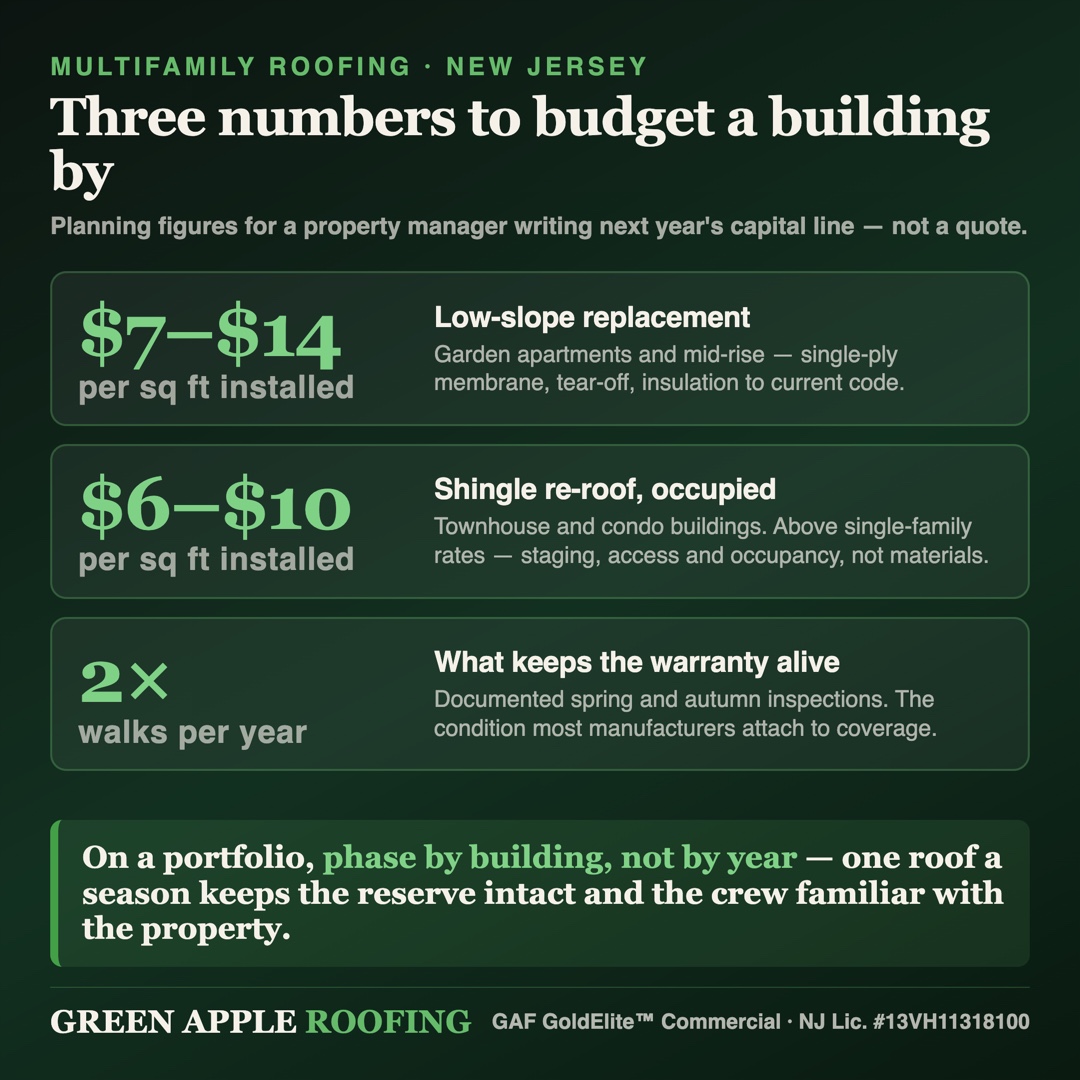
Budget a New Jersey multifamily roof at $7–$14 per square foot for low-slope membrane replacement, or $6–$10 per square foot for a shingle re-roof on townhouse-style buildings — both higher than the same roof on an empty building or a single-family house. The extra is not material. It is occupancy: staging that keeps residents' cars and entrances usable, tighter debris control, restricted work hours, phased buildings, more documentation, and a survey that has to satisfy a board rather than one homeowner. Plan on a survey-to-shovel timeline of several months if approval goes through a board, and phase a portfolio one building at a time rather than all at once.
Green Apple Roofing is a licensed, bonded and insured New Jersey roofing contractor (NJ Lic. #13VH11318100), GAF Master Elite® and GoldElite™ Commercial certified, and has completed roughly 3,000 roofs across the state since 2008 — commercial and multifamily as well as single-family. We work with property managers, owners and condo boards across Monmouth and Ocean counties.
Why a multifamily roof costs more than the same roof on a house
The membrane or the shingle costs what it costs. Everything around it changes when people live under the roof:
- Staging and access. On a single-family job the dumpster goes on the driveway. On a garden-apartment property it goes where it does not take resident parking, block a fire lane, or sit under a bedroom window at 7am — which usually means longer material carries and more labor hours.
- Debris control. Tear-off over occupied units means catch systems, tarped walkways and a magnet sweep at the end of every day, not the end of the job. Nails in a shared parking lot are a liability event, not an inconvenience.
- Restricted hours. Municipal noise ordinances plus a reasonable start time for residents compress the working day.
- Sequencing. A building has to be dried in every single night. That caps how much roof can be opened at once and slows the whole job relative to an unoccupied structure.
- Documentation. Boards and owners need photographs, daily logs and a closeout file. That is real time, and honest bids price it.
Which building do you actually have?
New Jersey multifamily stock splits into three roofing problems, and they price differently:
| Building type | Typical roof | What drives the budget |
|---|---|---|
| Garden apartments / low-rise | Low-slope single-ply, sometimes shallow shingle | Roof area per building, rooftop units, drainage |
| Mid-rise / elevator buildings | Low-slope single-ply, parapets, many penetrations | Access, crane or hoist time, detail count |
| Townhouse / condo rows | Pitched asphalt shingle, long shared ridges | Number of buildings, staging, association approvals |
On the low-slope side the membrane decision — TPO, EPDM or PVC — is covered in our single-ply commercial roofing guide, and the per-square-foot breakdown is in the commercial flat roof cost guide. On the pitched side, the underlying pricing is the same shape as a house — see the residential roof replacement cost guide — with the occupancy overhead on top.
What the survey has to produce before it goes to a board
A one-page quote will not survive a board meeting, and it should not. Require these from any contractor bidding your property:
- Measured roof area per building, not a property total. Boards approve buildings; reserves are held per building.
- Core cuts or a moisture survey on low-slope roofs, with photographs. This is the only way to know whether wet insulation makes a recover impossible.
- The existing layer count, so nobody discovers a second layer mid-job. Code generally limits a building to two.
- A per-sheet or per-board unit price for deck replacement, agreed in advance and billed only on what is used.
- A phasing plan with buildings in order, a duration per building, and the daily dry-in commitment written down.
- The resident communication plan — notice period, parking, working hours, who residents call.
- Certificates of insurance naming the association or ownership entity as additional insured, sent by the insurer.
- The warranty structure — labor and manufacturer terms separately, and who holds the paperwork afterwards.
That list is a longer version of the same discipline every roofing bid should meet; the residential version is what a real estimate should include, and the vetting checklist for the contractor themselves is how to choose a commercial roofing contractor.
Repair, recover or replace — the question the reserve study can't answer
Reserve studies age roofs on a table: installed in 2004, 25-year life, replace in 2029. Useful for planning, useless for deciding. The actual condition is set by drainage, detail work and how much water has already got into the insulation — which a core cut answers in an afternoon and a spreadsheet never will.
Three outcomes are possible, and only one of them is a full replacement. A sound membrane with isolated failures is a repair. A worn field over dry insulation with only one existing layer may qualify for a recover, which is materially cheaper and much less disruptive to residents. Trapped moisture, widespread seam failure or an existing second layer means replacement. The decision framework is in repair vs replace for a commercial flat roof, and it is worth running before the capital line is written, not after.
Phasing a portfolio
If you manage several buildings that went up in the same year, they will need roofs in the same year — and that is the trap. Doing them all at once empties the reserve, floods the property with crews and gives you a single failure date to face again in 25 years. Phasing one or two buildings a season keeps the reserve intact, gives you a crew that already knows the property, and staggers the next cycle. It also lets you fix the worst building first, which is what residents actually notice.
Between phases, the roofs you are not replacing still need looking after. Two documented walks a year and a written maintenance program is what keeps a manufacturer warranty valid and turns an emergency into a scheduled repair. If the last real inspection is more than a year old, start with a proper commercial roof inspection rather than a bid — you cannot budget a roof nobody has walked.
During the work: what residents should be told
Most complaints on a multifamily re-roof are about surprise, not about noise. A notice two weeks out and a second one the week of, naming the dates for their building, the working hours, where not to park, what the noise will be like and who to call, removes the majority of them. Interior vibration will knock things off shelves during tear-off — say so in advance and it is expected rather than a claim.
Get a per-building survey your board can approve
We survey every building separately, core-cut the low-slope roofs, photograph what we find, and give you an itemized scope with a phasing plan you can take to a board or an owner. Free survey, no obligation, no upselling — and we beat or match any legitimate quote on the same scope. Call (201) 681-0060 or get in touch. Recent New Jersey work is in the project gallery.
Commercial roofing questions, answered.
Free commercial roof survey.
We'll survey your roof, tell you honestly whether it needs repair, recover, or replacement, and give you an itemized bid you can actually compare. Same-day phone response.