
What a Real NJ Roofing Estimate Should Include (and the Five Lines That Mean You're Being Lowballed)
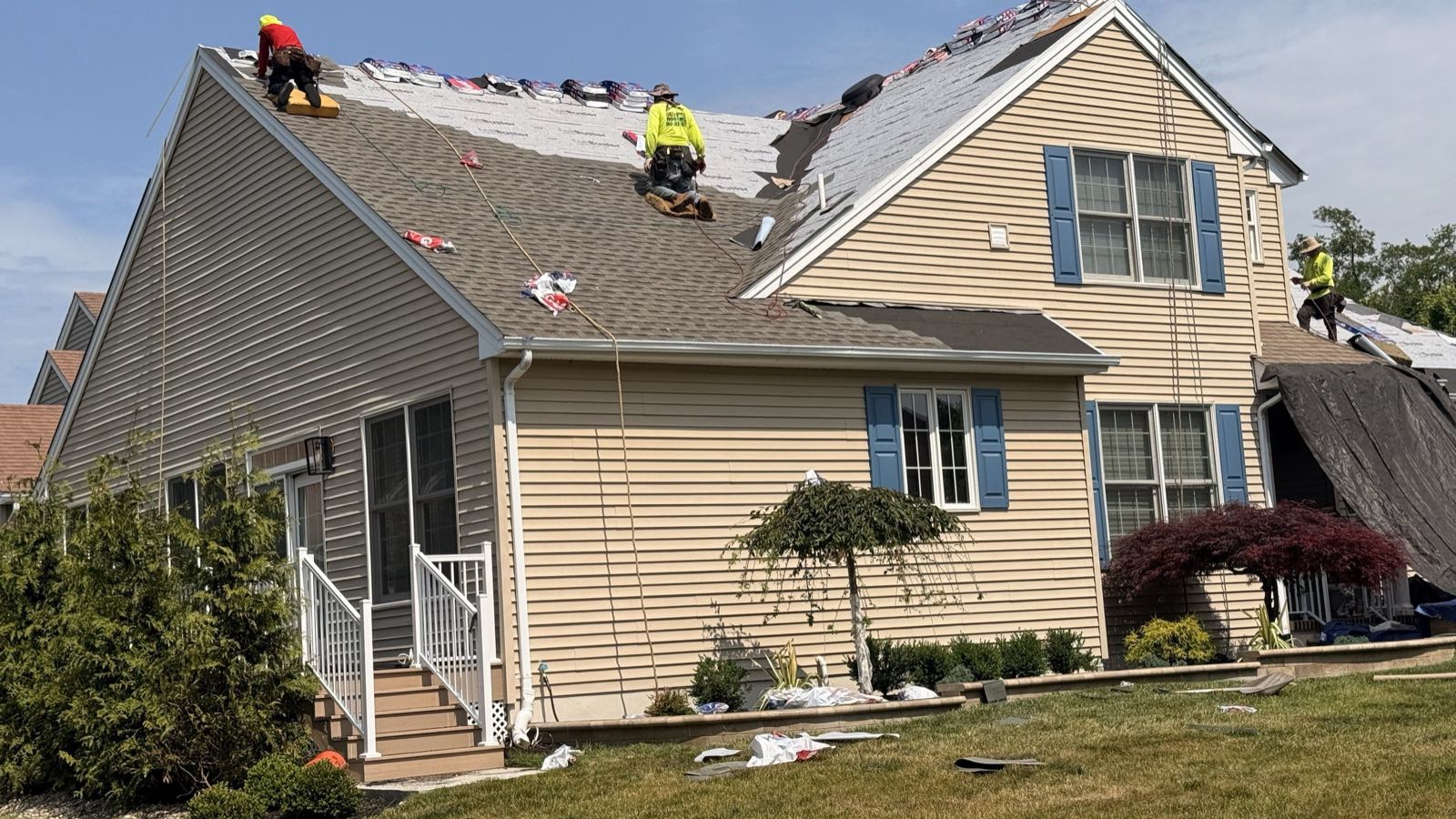
A real roofing estimate is a scope document with a price on the end of it — not a price with a sentence above it. In New Jersey it should name: the measured roof area in squares and the pitch, how many existing layers are coming off, a unit price for replacement decking, the underlayment and ice-and-water products by name and where they go, new flashing at every chimney, wall and valley, the ventilation being installed, starter and ridge, dumpster and disposal, the permit, the warranty terms split into labor and material, the contractor's NJ license number and current insurance, payment terms, and a start window. If a line is missing, it is not free — it is a change order waiting to happen.
Green Apple Roofing is a licensed, bonded and insured New Jersey roofing contractor (NJ Lic. #13VH11318100), GAF Master Elite® certified, veteran-owned and roofing New Jersey since 2008. We itemize every survey in writing, and we beat or match any legitimate quote — which only works if both documents describe the same roof. That is what this page is for.
Every line a real NJ roofing estimate carries
Print your estimate and check it against this. A proper one runs to a page or two. A single-line total is not a bid — it is a hope.
| Line | What it should actually say | Why it matters |
|---|---|---|
| Measured area | Squares and pitch, measured — not "approx." | Squares × pitch is the labor. A guess here moves everything. |
| Tear-off | How many existing layers come off | One layer priced, two found — that is the classic change order. |
| Deck / sheathing | Unit price per sheet replaced | Rot is normal. An unpriced "as needed" is a blank check. |
| Underlayment | Product named, and its coverage | The cheap substitution nobody sees once shingles are on. |
| Ice-and-water barrier | Eaves, valleys, and every penetration | Where NJ winter water actually gets in. |
| Flashing | New metal at chimneys, walls, valleys, vents | "Reuse existing" is the most expensive two words on a bid. |
| Ventilation | Intake and exhaust, with the products | Skipping it voids shingle warranties and shortens the roof. |
| Starter + ridge | Manufacturer starter strip and ridge cap | Cut-up shingles used as starter is a wind-warranty problem. |
| Disposal + protection | Dumpster, magnet sweep, landscaping protection | Otherwise it is billed after, or not done. |
| Permit | Who pulls it and who pays | Municipal in NJ. An unpermitted roof follows you to closing. |
| Warranty | Labor years and material years, separately | They are different promises from different parties. |
| License + insurance | NJ HIC number, and a current COI | Verify both. Do not take them as printed. |
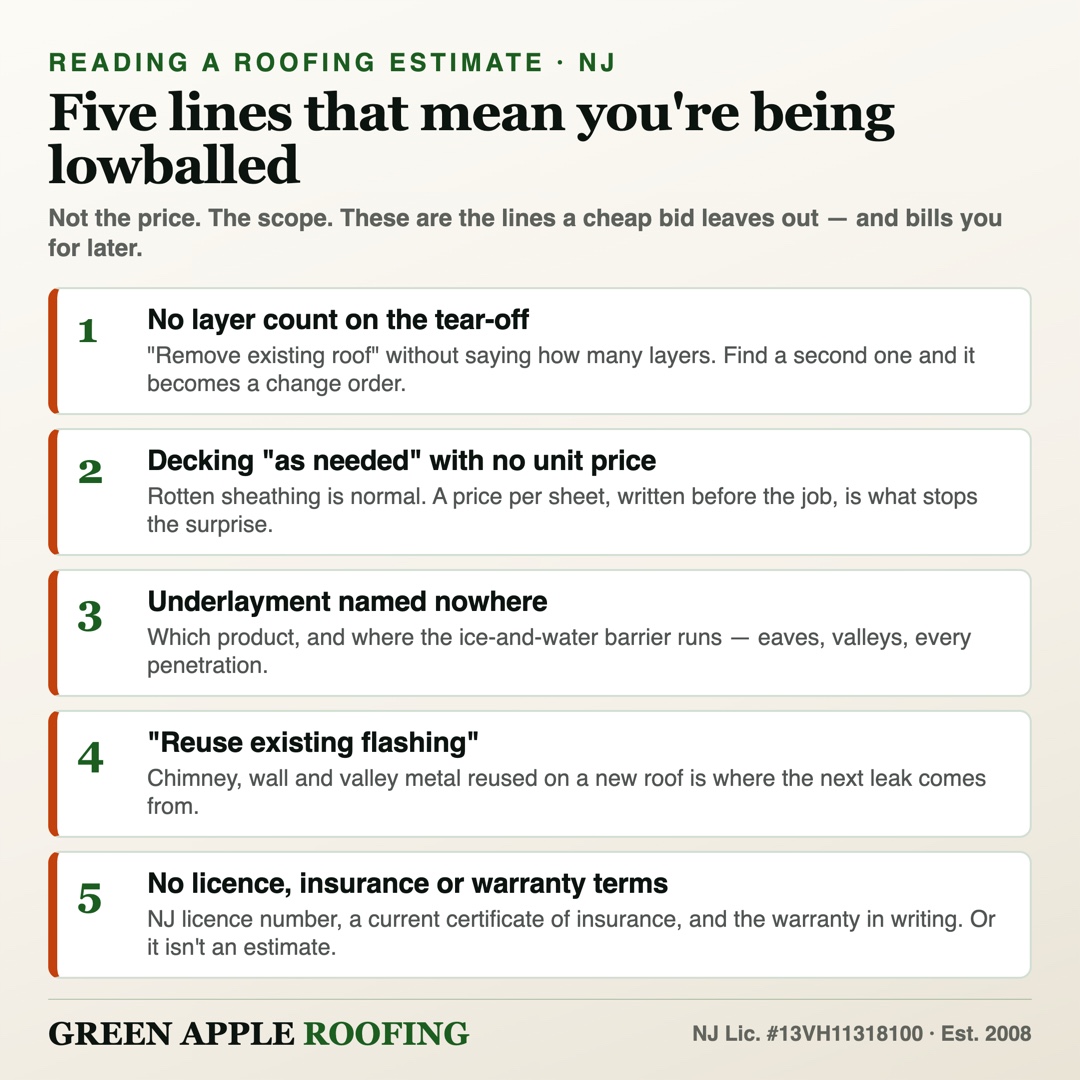
The five lines that mean you're being lowballed
1. "Remove existing roof" with no layer count
New Jersey code generally allows two layers of asphalt shingles before a full tear-off is required, and plenty of houses here are carrying two. Removing and hauling a second layer is real labor and real disposal weight. A bid that never states the layer count has priced one and will invoice for two the morning the crew finds it. Ask, and get the answer on the document.
2. Decking "replaced as needed"
Soft or rotten sheathing is normal and no honest roofer can quote the quantity before the old roof is off. That is not the problem. The problem is a bid with no unit price per sheet, because then the number is set after you have already committed and the roof is open. A real estimate says something like "replacement plywood at $X per 4×8 sheet, billed only for what is used, photographed before it is covered." Ask for the photographs — we take them as standard.
3. Underlayment that isn't named
"Felt" covers a $9 roll and a $120 roll. The estimate should name the synthetic underlayment product, and separately name the ice-and-water barrier and say where it runs — at minimum the eaves, every valley, and around every penetration. In New Jersey the eave membrane is what stops water backing up under the shingles in a freeze, so this line is not a formality. The mechanics are in our guide to what actually determines how long a roof lasts.
4. "Reuse existing flashing"
Flashing is the metal that seals the roof where it meets something else — a chimney, a sidewall, a valley, a vent pipe. It is also where most roofs leak. Reusing twenty-year-old flashing under new shingles saves a few hundred dollars and reintroduces the exact failure point you are paying to eliminate. New step flashing, new counter-flashing at masonry, new pipe boots, new valley metal. If it says "reuse," that is a decision someone made about your money without telling you.
5. No license number, no insurance certificate, no warranty terms
In New Jersey a home improvement contractor must be registered and must show the registration number. Ask for the number and a current certificate of insurance sent directly from the insurer — general liability and workers' compensation both. Then ask for the warranty in writing, split into labor (the contractor's own promise, worth exactly as long as the contractor exists) and material (the manufacturer's). Our full vetting checklist is how to choose a licensed NJ roofer, and the warranty side is unpacked in are roofing warranties worth it.
Why the cheapest number is usually the most expensive roof
There is no secret cheap way to buy shingles, and labor rates in Monmouth and Ocean counties are what they are. When one bid comes in dramatically below three others, the money came out of the scope — thinner underlayment, reused flashing, no ventilation work, cut shingles for starter, a crew without workers' compensation cover, or a change order that has already been planned. Same roof, different documents.
This is why we ask to see the other quote rather than just beat the number. If the low bid is genuinely the same scope, we match it. If it is not, we will show you the line where the difference lives — and you can decide with the facts in front of you.
How to compare two estimates that don't look alike
- Normalize the area first. If one bid says 28 squares and the other says 24, one of them measured and one guessed. Ask both how they got the number.
- Line up the tear-off. Same layer count, same disposal, or the prices aren't comparable.
- Compare the details, not the shingle. Most bids will quote a similar architectural shingle. The spread lives in flashing, underlayment, ventilation and decking terms.
- Read both warranties. A manufacturer's enhanced warranty usually requires a certified installer and a complete system — a bid that swaps in cheaper accessories may not qualify at all.
- Check the paperwork on both. License number, insurance certificate, permit responsibility, payment terms and a start window in writing.
What the number should roughly be
So the scope means something, you need a range to hold it against. Real 2026 New Jersey pricing for a residential replacement is broken down in our roof replacement cost guide, and commercial low-slope work is in the commercial flat roof cost guide. If you are not yet sure the roof needs replacing at all, start with the signs that it does — and if the damage is from a specific event rather than age, the insurance question changes who pays.
For a commercial building the same principles apply with more moving parts; the vetting version of this page is how to choose a commercial roofing contractor, and the membrane scope is in our single-ply roofing guide.
Get an itemized estimate — and bring us the other one
We survey the roof, measure it properly, and put every line above in writing so you can compare bids like for like. Free, no obligation, no pressure — and we beat or match any legitimate quote on the same scope. Call (201) 681-0060 or request a survey. Recent New Jersey jobs are in the project gallery.
Commercial roofing questions, answered.
Free commercial roof survey.
We'll survey your roof, tell you honestly whether it needs repair, recover, or replacement, and give you an itemized bid you can actually compare. Same-day phone response.