
Single-Ply Commercial Roofing: TPO vs EPDM vs PVC for Your NJ Building
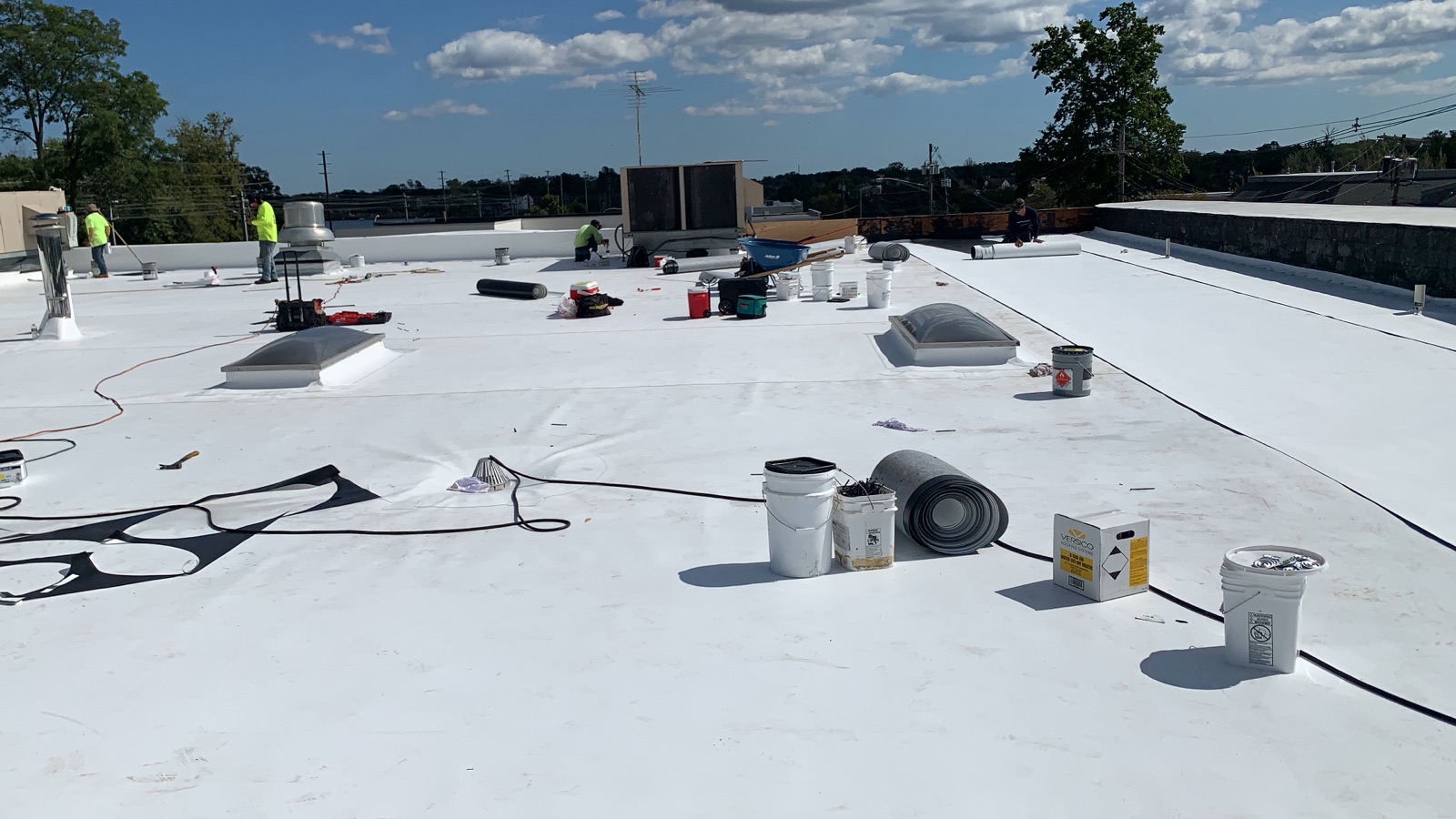
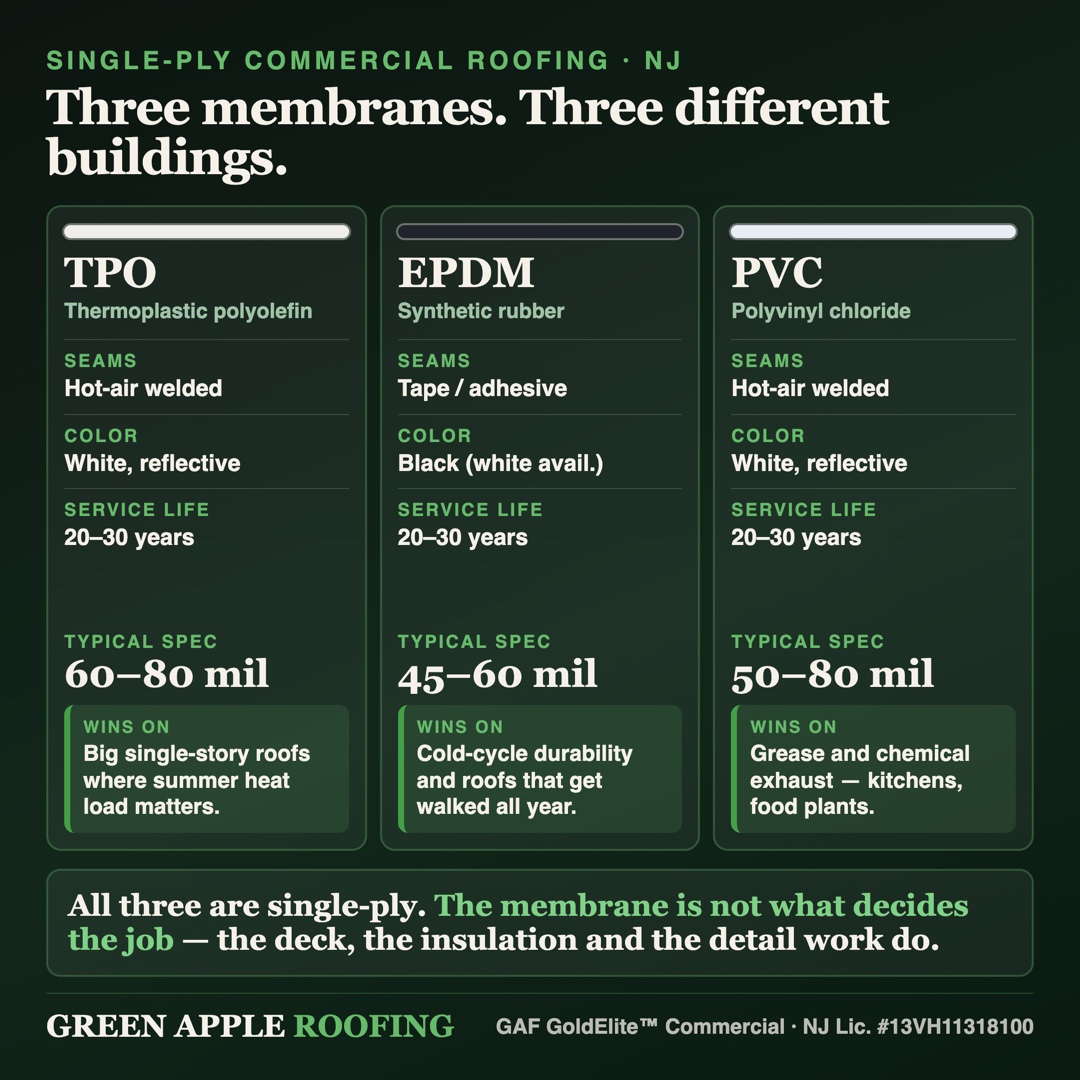
Single-ply roofing means one continuous sheet of membrane over the insulation — and in New Jersey that sheet is almost always TPO, EPDM or PVC. All three are proven, all three run roughly 20 to 30 years, and the installed cost gap between them is smaller than most owners expect. The choice comes down to the building: TPO for large single-story roofs where summer heat load matters, EPDM for roofs that get walked on year-round and see hard freeze-thaw cycling, and PVC where grease or chemical exhaust hits the roof — restaurants, commercial kitchens, food processing. This page is the overview; the head-to-head detail lives in the guides linked below.
Green Apple Roofing is a licensed, bonded and insured New Jersey roofing contractor (NJ Lic. #13VH11318100) and one of the few contractors in the state holding both GAF Master Elite® residential and GoldElite™ Commercial credentials. We install single-ply systems on commercial buildings across Monmouth and Ocean counties.
What "single-ply" actually means
A single-ply roof is an assembly, not a product. From the bottom up it's the structural deck (steel, concrete or wood), then rigid insulation boards, usually a cover board, and finally one layer of flexible membrane that gets sealed into a continuous waterproof plane. The name is literal: one ply of waterproofing, as opposed to the older multi-layer built-up roofs that stacked felts and asphalt.
That matters commercially for one reason: because there's only one waterproofing layer, every seam and every penetration is the roof. A single-ply roof almost never fails in the open field of the membrane. It fails at a curb, a pitch pan, a drain sump, a pipe boot, or a seam that was welded cold. When you're comparing bids, you're really comparing detail work — not brand names.
TPO — the default for big, hot roofs
TPO (thermoplastic polyolefin) is a white, highly reflective membrane whose seams are hot-air welded into a single fused sheet. It is the most-installed commercial membrane in the country right now, and on a wide single-story roof over conditioned space the reflectivity does real work: less heat into the deck means less load on the cooling plant through a New Jersey August.
Specify it at 60 mil or thicker. Forty-five mil TPO exists, it meets the standard, and it is the first thing a cheap bid quietly drops to. The thicker sheet buys you puncture resistance on a roof that service techs walk to get to the rooftop units. Full detail on the system, the warranty tiers and what goes wrong is in our TPO roofing guide.
EPDM — rubber, and still hard to beat in the Northeast
EPDM is a synthetic rubber membrane, traditionally black, seamed with tape and adhesive rather than heat. It has the longest field record of the three in the Northeast — there are EPDM roofs in New Jersey now past thirty years — and it handles the freeze-thaw cycling of a Jersey winter without complaint. It is also more forgiving underfoot than a thermoplastic sheet, which is why it still gets specified for roofs crowded with equipment.
The trade-off is color. A black membrane absorbs heat instead of rejecting it, so on a large conditioned building it can work against your cooling bill. White EPDM exists and closes part of that gap at a price premium. The head-to-head — including how the two systems age differently — is in TPO vs EPDM for NJ flat roofs.
PVC — the one nobody writes about, and the right answer more often than you'd think
PVC is the third single-ply, and the one most contractor blogs skip. Like TPO it is a white thermoplastic with hot-air welded seams, so it behaves similarly on the roof. The difference is chemistry: PVC resists animal fats, grease and many industrial chemicals, and TPO does not.
That single property decides a lot of New Jersey buildings. If your roof has a kitchen exhaust fan on it, the grease that fan throws will degrade a TPO membrane around the curb, and you will be repairing that area on a cycle for the life of the roof. Restaurants, diners, supermarkets with in-store bakeries, food processors and some manufacturing all belong on PVC. It typically carries a modest premium over TPO — and on a grease-exposed roof it is cheaper by the second repair.
| TPO | EPDM | PVC | |
|---|---|---|---|
| Material | Thermoplastic polyolefin | Synthetic rubber | Polyvinyl chloride |
| Seams | Hot-air welded | Tape / adhesive | Hot-air welded |
| Standard color | White, reflective | Black (white available) | White, reflective |
| Typical thickness | 60 – 80 mil | 45 – 60 mil | 50 – 80 mil |
| Service life | 20 – 30 yrs | 20 – 30 yrs | 20 – 30 yrs |
| Grease / chemical resistance | Poor | Poor | Excellent |
| Relative installed cost | Baseline | Slightly below | 10 – 20% above |
How the membrane is attached matters as much as which membrane
Three attachment methods show up on New Jersey bids, and they are not interchangeable:
- Mechanically fastened — the sheet is screwed through to the deck along the seam lines. Fastest, usually cheapest, and the most common. The membrane flutters slightly in high wind, which is normal but does load the fasteners.
- Fully adhered — the sheet is glued across its whole face. Quieter, flatter, better wind-uplift performance, and the usual specification on taller buildings and anywhere near the shore. Costs more.
- Ballasted — the sheet is loose-laid and held with stone. Rare on new work now and effectively a non-starter if the deck can't carry the weight.
Along the Jersey Shore, wind uplift is the design condition that quietly drives this decision — a building in Point Pleasant or Long Beach Island has a different fastening pattern than the same building in Freehold. If two bids differ by a lot and one is mechanically fastened while the other is fully adhered, you are not looking at the same roof. That is exactly the kind of line a good bid spells out; see how to vet a commercial roofing contractor.
What actually moves the price
Owners tend to assume the membrane choice drives the number. It does not — it is usually the smallest variable on the bid. What moves a New Jersey single-ply price is tear-off versus recover, how much insulation the current energy code makes you add, how many penetrations and curbs the roof carries, and how hard the roof is to reach. Real per-square-foot ranges are broken down in our commercial flat roof replacement cost guide.
One line worth understanding before you compare bids: a recover goes over the existing roof and a tear-off doesn't. Code generally allows a building only two roof layers, so a recover is a one-time option. Whether your roof still qualifies — and whether it should — is the repair-or-replace question.
What kills a single-ply roof early
In our experience across roughly 3,000 roofs since 2008, single-ply systems rarely die of old age. They die of four things: blocked drains that leave water standing on the membrane, foot traffic from HVAC and telecom techs with no walkway pads to travel on, penetrations added after the fact and flashed badly, and seams nobody ever looked at. All four are cheap to catch and expensive to ignore.
Two inspections a year and a written maintenance program is what turns a failure into a scheduled repair — and on most manufacturer warranties it is also the condition that keeps your coverage alive. If it has been more than a year, start with a proper commercial roof inspection rather than a bid. And if the roof is leaking right now, the first hour matters more than the membrane debate: see what to do when a flat roof is actively leaking.
So which one for your building?
- Grease or chemical exhaust on the roof? PVC. This overrides everything else.
- Large, single-story, conditioned space with real summer cooling load? TPO at 60 mil or better, white.
- Roof that is walked constantly, or a building where the deck and details favor a forgiving sheet? EPDM.
- Exposed shore-front elevation? Whatever the membrane, argue for fully adhered and a tightened fastening pattern.
- Still not obvious? Then the membrane isn't your decision — the insulation, the drainage and the detail scope are. Get those specified and the sheet almost picks itself.
Get a single-ply spec you can actually compare
We'll survey your roof, tell you honestly whether it needs repair, recover or full replacement, and put the membrane, thickness, attachment method and every detail in writing so two bids can be read side by side. Free survey, no obligation, no upselling — and we beat or match any legitimate quote. Call (201) 681-0060 or get in touch. See recent work in the project gallery.
Commercial roofing questions, answered.
Free commercial roof survey.
We'll survey your roof, tell you honestly whether it needs repair, recover, or replacement, and give you an itemized bid you can actually compare. Same-day phone response.