
Roof Scupper, Drain or Parapet: Where a Flat Roof Actually Drains
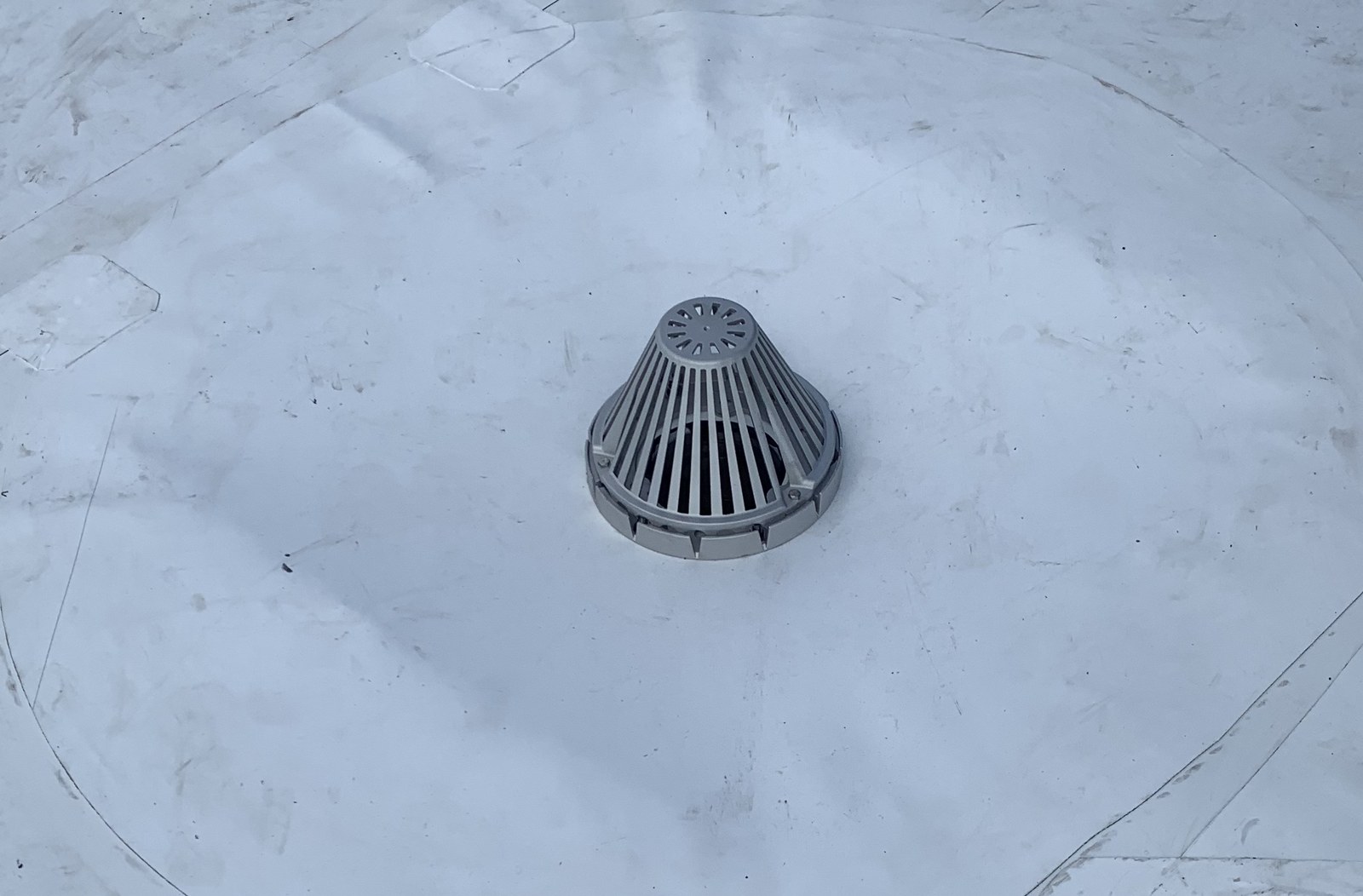
A flat roof drains in one of three ways: through interior drains in the roof field, through a roof scupper in the parapet wall, or over an open edge into a gutter. Where a parapet would trap water if the drains clogged, the building code requires an overflow drain or scupper on new buildings.
Green Apple Roofing is an NJ-registered Home Improvement Contractor #13VH11318100, insured, and a GAF GoldElite™ Commercial contractor, in business since 2008, and our office is in Ocean Township. This guide names the drainage parts a building owner sees on a bid, explains what each one does, and shows where each one fails.
The three ways water leaves a flat roof, and the overflow
Every low-slope roof is built to move water toward a planned exit. On New Jersey commercial buildings you will see one or more of these:
| Outlet | Where it sits | Its job | Where it tends to fail |
|---|---|---|---|
| Interior roof drain | In the roof field, at a low point | Carries water down a pipe inside the building | Clogged strainer; membrane loose at the clamping ring |
| Scupper | An opening through the parapet at roof level | Lets water out through the wall to a conductor head and downspout | Inside corners of the metal box; packed conductor head |
| Open edge with gutter | Along a roof edge with no parapet | Sheds water over edge metal into a gutter | Edge metal joints; gutter overflowing against the wall |
| Overflow (secondary) | Set higher than the primary drain or scupper | Takes water only when the primary is blocked | Missing entirely, or set too low to stay dry |
None of these work unless the roof slopes toward them. Where the slope is wrong, the fix is tapered insulation and crickets, and that side of the problem is covered in our guide to ponding water on a flat roof. This piece is about the outlets themselves.

Interior drains: the bowl, the clamping ring and the strainer
An interior roof drain is a metal bowl set into the deck and connected to a leader pipe that runs down inside the building. The roof membrane runs into the bowl and is held there by a clamping ring bolted down over it. A domed strainer sits on top to keep leaves and debris out of the pipe.
Three things go wrong. The strainer clogs with leaves, or goes missing and lets debris into the leader, which is a bigger job to clear. The clamping ring loosens or loses a bolt, so water gets under the membrane at the one spot on the roof that is always wet.
The leader pipe can also block or crack inside the building, which a roofer can identify; the pipe itself is plumbing work. A drain that is clear on top but still holds water in its bowl a day after rain points to the pipe, not the roof.
Scuppers: the opening in the parapet
A roof scupper is an opening through the parapet wall at roof level, lined with sheet metal, that lets water run out sideways instead of down through the building. On the outside it usually empties into a conductor head, the collector box on the wall, which feeds a downspout. Scupper versus downspout is not a choice: the scupper is the exit, and the conductor head and downspout carry the water to the ground.
The weak point is where the flat membrane meets the metal box. The membrane has to be turned into the opening and sealed across the bottom and up both inside corners, and those corners are where splits and dried-out sealant show up. The conductor head is the other failure: leaves pack into it, the scupper backs up, and water stands against the parapet until it finds a way over or behind the flashing.
Overflow: the outlet that should stay dry
An overflow is a second outlet, either a scupper through the parapet or a separate drain, set a little higher than the primary one. On an ordinary day it does nothing. When the primary blocks, water rises until it reaches the overflow and leaves there instead of building up on the roof.
That makes it an alarm as much as an outlet. An overflow with staining under it, or one you see running after an ordinary rain, is telling you the primary is blocked. Clear the primary; do not treat the overflow as the drain.
As of October 2026, New Jersey's building code (the 2024 International Building Code, Section 1502.2, adopted effective August 17, 2026) requires secondary (emergency overflow) drains or scuppers on new buildings where a flat roof has drains and a parapet that would trap water if the drains clogged. Work on existing buildings, including a re-roof, falls under the state's Rehabilitation Subcode (N.J.A.C. 5:23-6.8), which does not apply that section.
So a re-roof in New Jersey is not required to add overflows. It also may not reduce existing system capacity below what exists or what the code requires, whichever is lower (N.J.A.C. 5:23-6.4(c) and 6.5(c)). If a re-roof bid on a parapet building leaves an existing overflow out, ask why.
This is general information, not legal advice; your local construction office has the final word.
Parapets: the wall that holds the water in
A parapet is the low wall that extends above the roof around its edge. It keeps water on the roof until it reaches an outlet, which is exactly why every joint in it matters. Three details keep it watertight:
- Base flashing: the membrane turned up the inside face of the wall, so water standing at the wall meets flashing, not masonry.
- Termination bar: a metal strip fastened and sealed along the top edge of that flashing, so the flashing cannot peel away from the wall.
- Coping cap: the metal or stone cap across the top of the wall. Its joints have to stay closed, or rain falling on the wall runs down inside it.
Parapet leaks fool people. Water that gets in at an open coping joint runs down inside the wall and comes out behind the base flashing, so the stain inside the building sits near the wall and looks like a drain or membrane leak. When a parapet roof leaks only in wind-driven rain, the coping joints are the first place to look.
Open edges, gutters and edge metal
Some low-slope roofs have no parapet on one or more sides. There, water runs to the edge, over edge metal (a formed strip that clamps the membrane at the perimeter) and into a gutter. A flat roof should have a gutter wherever it drains over an open edge, especially above a doorway, a walkway or a lower roof; without one, water drops off the edge and soaks the wall below.
Edge metal fails at its joints and wherever it was fastened through the membrane without a strip of membrane covering the fasteners. Green Apple installs gutters as well as roofs.
Reading a bid: the parts by name
Drainage work shows up on a commercial roof bid as a list of parts. The drain body, strainer, clamping ring, scupper box, conductor head, overflow, coping cap and termination bar are all described above. Two more turn up often:
- Cricket: a wedge of tapered insulation that steers water around an obstruction or toward an outlet.
- Pitch pocket: a filled collar around an irregular penetration, such as a bundle of conduit or a steel support. The filler shrinks over time and needs topping up.
If a bid says only "flashing repair" or "drain work", ask which of these parts, how many, and where. A clear bid names them.
October: check the outlets before they leak
Leaves come down through October and November, and nor'easters hit New Jersey most often between October and April, according to the State Climatologist at Rutgers. A strainer that was clear in August can be buried by the first heavy rain after the leaves drop. If the roof access is safe, a fall check looks like this:
- Clear every strainer and scupper by hand, and confirm each strainer is seated and fastened, not lying loose beside the drain.
- Look into each conductor head. Packed leaves there back the scupper up even when the scupper itself looks clear.
- Check under the overflows. Staining below an overflow means the primary has been blocked at some point.
- Walk the parapet. Look for open coping joints and flashing pulling away from under a termination bar.
- Look again after the next rain. Water still standing days after the rain stops is ponding, not drainage, and the ponding guide covers what to do about it.
Doing this every fall and again in spring is the core of a commercial roof maintenance plan.
Water backed up at a blocked drain or scupper rises until it finds the weakest seam or flashing nearby. Inside, the leak may show some distance away, because water travels through the insulation before it drops.
If water is already coming through the ceiling, start with what to do when a flat roof is actively leaking. If it is not, but you have overflows that run, coping joints you can see light through, or ponds that keep coming back, a commercial roof inspection will tell you which outlet is the cause.
Have every outlet on the roof checked this fall
Ask us to look at the roof and every outlet on it: drains, scuppers, overflows and parapet joints. Same-day response, and a 24-hour emergency line if water is already inside. We'll beat or match any reliable, legitimate roofing, siding or gutter quote. Veteran and first-responder discount — mention it when you book. Based in Ocean Township; serving Monmouth and Ocean counties and all of New Jersey, including Asbury Park. Call (201) 681-0060 or get in touch.
Commercial Roofing questions, answered.
Commercial Roofing
Ponding Water on a Flat Roof: When It's Normal and When It's a $40k Problem
ReadCommercial Roofing
Apartment & Multifamily Roof Replacement in NJ: What Property Managers Should Budget and Expect
ReadCommercial Roofing
Single-Ply Commercial Roofing: TPO vs EPDM vs PVC for Your NJ Building
ReadRequest a commercial roof survey.
We'll survey your roof, tell you honestly whether it needs repair, recover, or replacement, and give you an itemized bid you can actually compare. Same-day phone response.