Cool Roofs for NJ Commercial Buildings: What a White Roof Saves
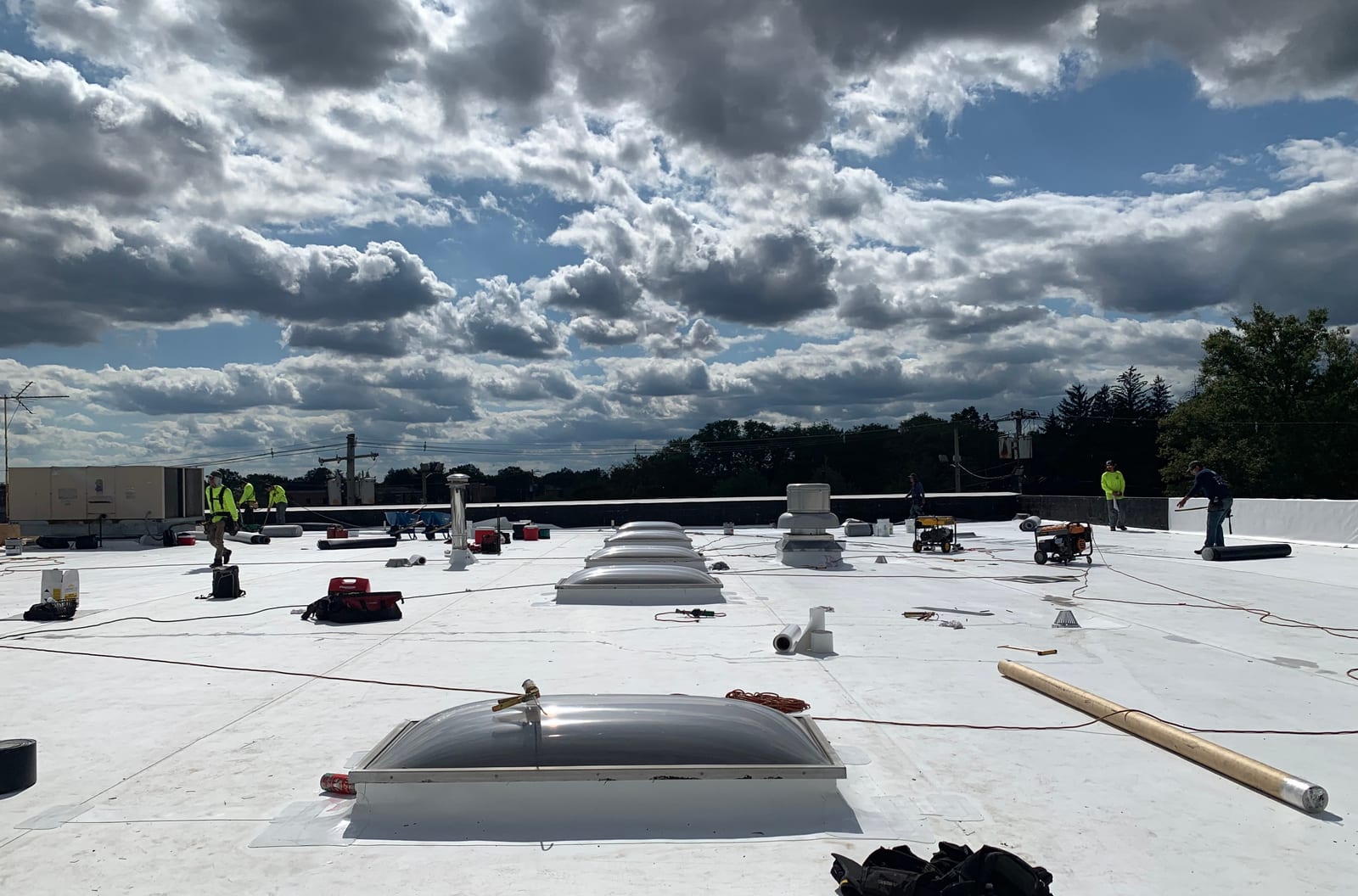
A cool roof, such as a white membrane, saves on summer cooling. On a typical summer afternoon, a clean white roof that reflects 80% of sunlight stays about 55°F cooler than a gray roof that reflects 20%, according to Lawrence Berkeley National Laboratory. Less heat at the roof means less heat for the air conditioning to remove. What that is worth in dollars depends on your building.
The EPA publishes a percentage, and it is about houses: in air-conditioned homes, the EPA says a cool roof can cut peak cooling demand by 11–27%. That is a residential figure, and a cut in peak demand rather than in the bill. It does not transfer to a one-story store or a four-story office. A number for your building has to come from your building.
Green Apple Roofing is a GAF GoldElite™ Commercial contractor, listed by GAF as a single-ply roofer, and a GAF Master Elite® residential contractor. We are an NJ-registered Home Improvement Contractor (#13VH11318100), insured, and work out of our office in Ocean Township, serving Monmouth and Ocean counties and all of New Jersey, from Toms River to Freehold. Green Apple was founded in 2008. Commercial roofing is a focus of our work.
What makes a cool roof "cool"
Two properties make a roof "cool": solar reflectance and thermal emittance. Both are measured from 0 to 1, where 1 means 100% reflective or emissive, according to the Cool Roof Rating Council. Reflectance is the share of sunlight the surface bounces straight back. Emittance is how readily it gives off, as heat, the sunlight it did absorb.
Specifications often use one number instead. Solar Reflectance Index (SRI) combines reflectance and emittance into one number on a scale where a standard black surface is 0 and a standard white surface is 100, calculated under ASTM E1980 (CRRC explainer). The higher the SRI, the closer the surface runs to that standard white in the sun.
Two things are worth knowing before you compare products. First, the Cool Roof Rating Council publishes each rated product's values both new and after three years outdoors, in its Rated Roof Products Directory. Ask for both; the three-year value is closer to the roof you will actually own. Second, ENERGY STAR no longer certifies roofing. EPA ended the roof products program on June 1, 2022, so an ENERGY STAR roof label in a sales pitch is out of date.
A cool roof also does not have to be white; some darker "cool color" products reflect strongly in the invisible infrared. On a flat commercial roof, though, white is the familiar case, and it is the one this article is about.
Where the saving comes from
In summer a dark roof turns sunlight into heat at the top of the building, and some of that heat works its way down into the space below. A white roof sends more of the sunlight back out before it ever becomes heat. Less heat comes through the roof, so the rooftop units run less to hold the same temperature inside.

The saving is largest where the roof is a big share of the building's skin and the space under it is cooled:
- One-story buildings with large footprints: retail, offices, medical suites and light industrial space, where every square foot of roof sits directly over conditioned rooms.
- Buildings cooled for long hours, or with heavy internal heat from kitchens, server rooms or dense occupancy, where the air conditioning is already working hard.
- Roofs in full sun, with no taller neighbor, tree line or bank of rooftop equipment throwing shade across the field.
It is smallest on multi-story buildings, where the roof sits over only the top floor; on unconditioned warehouses, where a cooler roof makes the space more comfortable to work in but does not show up on a utility bill; and on roofs that sit in shade for much of the day.
The winter side of the ledger
New Jersey buildings heat as well as cool. Cool roofs may increase energy use in winter in cold climates, but the EPA says this so-called "heating penalty" is typically offset by summer cooling energy savings. We found no New Jersey-specific figure for it, so we don't print one.
That leaves one real question for whether a cool roof is worth it: how much does your building cool? On a building that spends real money on air conditioning, white earns its keep. On one that barely cools at all, there is little summer saving to start with. Your own utility bills, read month by month across a full year, show which kind of building you own.
Ask for the three-year number
Notice the word clean in the laboratory figure above. It is the reason to compare the three-year rating, not the new one, when you weigh products.
Housekeeping still matters: a defined route for service crews to the rooftop units, drains kept clear so water leaves, and debris taken off during routine roof checks. Whether a membrane may be washed, and with what, is set by its manufacturer's care instructions. Follow those, not a pressure washer.
White or dark: settle it in the quote
The replacement quote is the moment to settle color, with the building's use in front of you rather than a sample board.
| White membrane | Dark membrane | |
|---|---|---|
| Summer sun | Reflects more; surface stays cooler | Absorbs more; surface runs hotter |
| Winter sun | Takes in less warmth | Takes in more warmth |
| Fits | One-story, sun-exposed, cooled buildings | Shaded roofs, mostly heated buildings |
This article is only about the surface. The membranes themselves differ in seams, chemistry and how they hold up, and that comparison lives in TPO vs EPDM vs PVC for your NJ building. If you are already leaning white, start with what a white TPO roof is and what it costs.
What the switch involves on an NJ building
A new membrane on a commercial building is permit work. As of October 2026, New Jersey's re-roofing exemption (N.J.A.C. 5:23-2.7) covers only detached one- and two-family homes. Townhouses, multi-family and commercial roofs, and any work that affects the structure, still go through the permit process.
Whether the new roof can go over the old one is the next question, and as of October 2026 N.J.A.C. 5:23-6.4 sets the answer. In New Jersey, the existing roof covering must be removed before a new one goes on when it is water-soaked or has deteriorated to the point that it is not adequate as a base for additional roofing, when it is wood shake, slate, clay, cement or asbestos-cement tile, or when it already has two or more layers.
A core cut through the existing roof answers that before anyone prices the job. The price itself, with what moves it, is in commercial flat roof replacement cost in NJ.
Then there is the energy code. As of October 2026, in New Jersey, commercial buildings meet the energy code through ASHRAE Standard 90.1 (DCA model-code adoption). NJ deleted the IECC's commercial envelope section (C402, which holds the IECC roof-reflectance rule). Whether the standard sets a reflectance requirement for your project is a question for your local construction office, which reviews the permit; we don't answer it from memory.
This is general information, not legal advice; your local construction office has the final word.
What a white roof won't do
Reflectivity is a property of the top surface and nothing else. It does not stop leaks, it does not change what is under the membrane, and it does not make up for a roof that has reached the end of its life. A white membrane that is failing at its seams and flashings needs the same attention as a black one.
What protects an owner over the long run is the installed system and its warranty, not its color. GAF GoldElite™ Commercial contractors can offer the GAF Diamond Pledge™ NDL Roof Guarantee, with coverage up to 25 years on qualifying systems.
For a savings estimate on your own building, the people to ask are your mechanical engineer or HVAC contractor, who can model the cooling load. Our part is the roof: what is on it now, what condition it is in, and what a replacement would involve.
Replacing a commercial roof? Settle the color in the quote
Tell us about the building and we'll quote the replacement. Same-day response, and we'll beat or match any reliable, legitimate roofing, siding or gutter quote. Veteran and first-responder discount — mention it when you book. Call (201) 681-0060 or request a commercial roof quote.
Commercial Roofing questions, answered.
Request a commercial roof survey.
We'll survey your roof, tell you honestly whether it needs repair, recover, or replacement, and give you an itemized bid you can actually compare. Same-day phone response.