
Edge Metal and Parapet Coping: Where a Commercial Roof Fails First in a Wind Storm
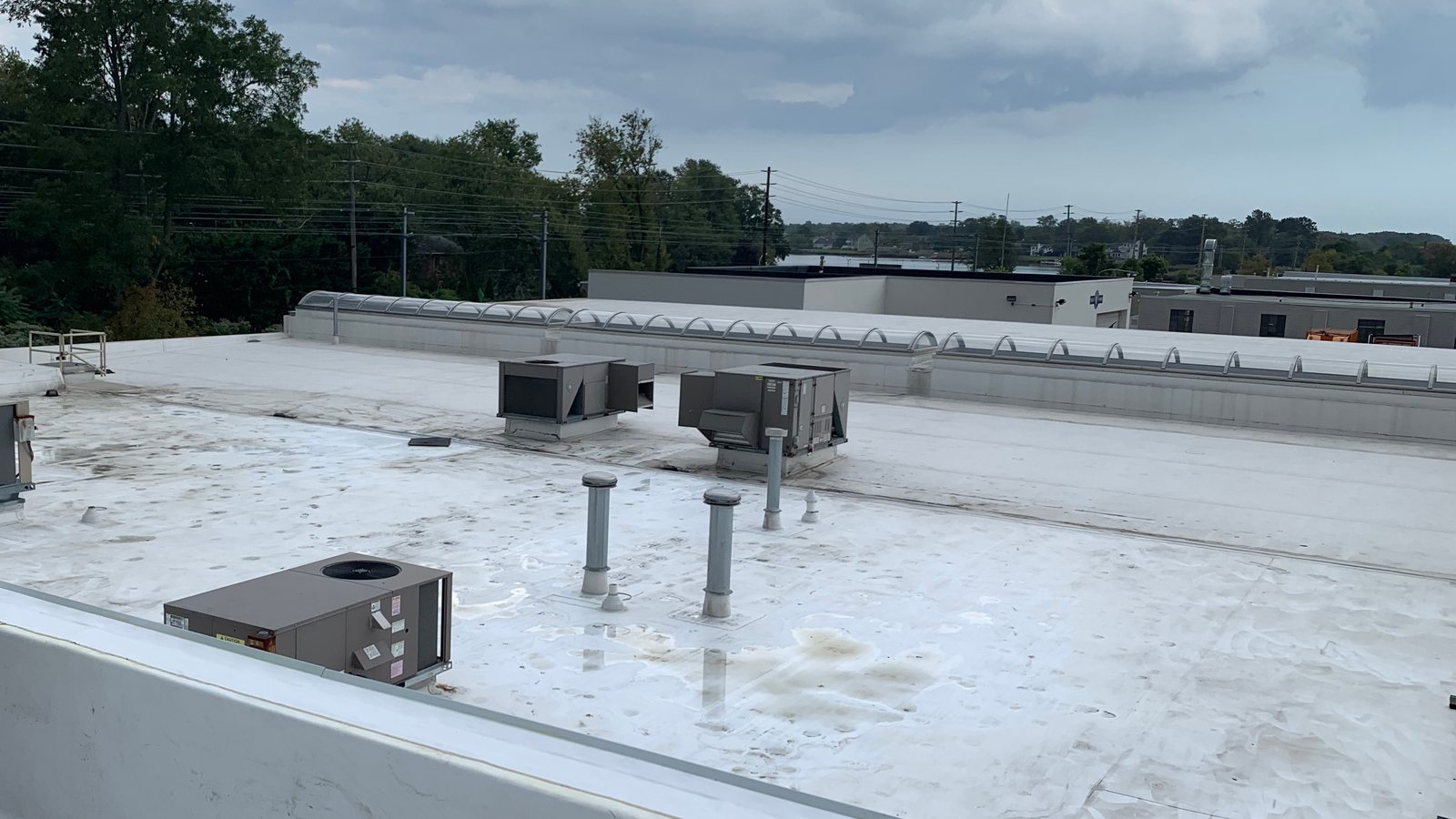
Short answer. Wind pulls hardest on the edges and corners of a flat roof. If the edge metal or parapet coping loosens, wind gets under the membrane and can peel it back across the roof. Loose or bent metal, open joints, missing fasteners, rust and stains below the coping are the warning signs. Securing the perimeter before winter storms is one of the most cost-effective jobs on a commercial roof.
Why the edge is the weak point
When wind blows across a building, the air speeds up as it passes over the roof edge. That creates suction, called uplift, that is strongest at the perimeter and strongest of all at the corners. Engineering standards for roof attachment treat the corners and perimeter as higher-pressure zones than the middle of the roof for exactly this reason.
The edge metal or coping is what holds the membrane down along that line. If it is loose, under-fastened or damaged, wind can get under the membrane at the edge. Once the edge lifts, the rest of the roof is exposed to a force it was never designed for, and a small failure becomes a large one in a single storm.
New Jersey's coastal counties see nor'easters every winter and tropical storm remnants in late summer and fall. Monmouth and Ocean county buildings near the water take more wind than inland buildings.
The three kinds of roof edge
1. Edge metal (drip edge or fascia metal)
On roofs without a parapet wall, the membrane runs to the outside edge of the building and is held by a metal edge. It may be a simple drip edge, a gravel stop on older ballasted or built-up roofs, or a two-piece fascia system with a continuous cleat that clips the face down.
2. Parapet coping
Many commercial buildings have a parapet: a short wall that rises above the roof. The top of the parapet is capped with metal coping that sheds water off the wall and holds down the membrane where it wraps up and over. Coping joints, fasteners and the cleats underneath are all part of the system.
3. Gutters and scuppers at the edge
Where water leaves the roof through scuppers or into gutters, the edge has openings that have to be flashed into the membrane. See where a flat roof actually drains: scuppers, drains and parapets.
Warning signs at the perimeter
From the ground:
- Edge metal or coping that is bent, lifted, wavy or missing in sections.
- Gaps at coping joints.
- Rust streaks or dark staining on the wall below the coping.
- Water stains or efflorescence (white mineral deposits) on parapet walls.
- Sealant hanging from joints.
From the roof:
- Fasteners missing, backed out or rusted.
- Membrane pulling away from the edge, or wrinkles running in from the perimeter.
- Splits in the membrane where it turns up a parapet.
- Wet or soft areas near the edge.
- Loose cleats when the coping face is pressed.
After any significant wind event, the perimeter should be the first thing checked.
What goes wrong with older edge details
- Under-fastened metal. Older installations often used fewer fasteners, or nails that work loose.
- No continuous cleat. Without a continuous cleat holding the outer face, metal can flutter and fatigue in wind.
- Sealant-only joints. Joints that depend on sealant alone open up as the metal expands and contracts through NJ's temperature swings.
- Rusted steel. Painted steel edges rust at cut ends and fasteners, especially near salt air.
- Membrane not terminated properly. If the membrane is not secured at the edge before the metal goes on, the metal is the only thing holding it.
How the perimeter is secured or replaced
The right repair depends on what is there:
- Re-fastening and re-sealing. Where the metal is sound, adding fasteners and resealing joints with the proper cover plates or splice details can restore it.
- Replacing sections. Damaged, rusted or bent sections are replaced, tied into the existing system.
- Full perimeter replacement. Older systems are replaced with a tested edge system: a continuous cleat, correct fasteners and coping or edge metal that matches the membrane manufacturer's details.
- Membrane termination and flashing. The membrane is secured at the edge and flashed up and over the parapet before new coping goes on.
Many membrane manufacturers require approved edge details as a condition of the roof warranty. See commercial roof warranties: what each type covers and what voids one.
Edge work during a roof replacement
When a commercial flat roof is replaced, the perimeter is replaced with it. That is the time to:
- raise parapet flashings for any added insulation height;
- install a continuous cleat and new coping;
- use edge metal in a finish that suits the building and the location (aluminum or coated steel near the shore);
- confirm the edge system matches the warranty requirements.
Read how a TPO roof is installed and recover or tear off.
Why the perimeter is worth checking before winter
A loose section of coping found in a fall inspection is a small repair. The same section found after a nor'easter may come with a peeled membrane, wet insulation and interior damage. See flat roof leak emergency for what to do when water is already coming in, and commercial roof maintenance in NJ for a twice-a-year routine.
A perimeter checklist for owners and managers
- Have the perimeter checked twice a year and after every major storm, by trained, authorized people using safe roof access.
- Look for loose, bent or missing metal and open joints.
- Check the wall below the coping for rust and water stains.
- Note any membrane pulling away from the edge.
- Keep photos with dates so changes are easy to see.
- Call a roofer before winter if anything has moved.
Parapet walls: more than the coping
The coping is only the top of the parapet. The wall itself has to stay dry as well. Brick or block parapets absorb water, and in New Jersey freeze-thaw cycles that water expands and cracks mortar joints. Over time a wet parapet can push the coping out of line, loosen the membrane flashing on the roof side and stain the wall on the street side.
Things to check on the wall itself:
- open or crumbling mortar joints;
- cracks or bulges in the brick or block;
- loose or missing counterflashing where the membrane turns up the wall;
- vegetation growing out of joints;
- wet areas on interior walls just below the roof line.
A roofer and, where needed, a mason should look at the parapet together, because roof flashing and wall repairs depend on each other.
Corners: where to look first
Because corners take the highest wind loads, corner sections of edge metal and coping are often the first to loosen. They are also where two runs of metal meet, so joints and corner pieces are more complex. When you walk the perimeter, start at the corners and spend the most time there.
After a storm: a quick perimeter response
If a storm has lifted part of the edge:
- Keep people off the roof until it is safe and the wind has dropped.
- From the ground, photograph the damage and note where it is.
- Do not try to nail down loose metal in the wind; a sheet of loose metal is dangerous.
- Call a roofer to secure the edge temporarily and check the membrane.
- Check the interior below the damaged area for water.
- Contact your insurer if there is damage, with your dated photos.
Material choice near the shore
Edge metal and coping come in galvanized or coated steel, aluminum, and in some cases stainless steel or copper. Near the coast, salt air speeds up corrosion at cut edges, fasteners and scratches. Many owners of shore buildings choose aluminum or a high-performance coated finish, with fasteners that match the metal so they do not corrode each other. Ask what the finish warranty covers in a coastal location.
Green Apple Roofing is a GAF Master Elite contractor and an NJ-registered Home Improvement Contractor #13VH11318100, serving Monmouth and Ocean counties from our Ocean Township office. Free roof survey, no obligation; we beat or match any legitimate quote. See commercial roof repair and commercial roofing.
Questions owners ask
Commercial Roofing
Rooftop Units and Foot Traffic: How HVAC Service Visits Wear a Commercial Roof
ReadCommercial Roofing
Recover or Tear Off: When a New Membrane Can Go Over an Old Commercial Roof in NJ
ReadCommercial Roofing
How a TPO Roof Goes On: What the Crew Does From Tear-Off to the Last Seam
ReadRequest a commercial roof survey.
We'll survey your roof, tell you honestly whether it needs repair, recover, or replacement, and give you an itemized bid you can actually compare. Same-day phone response.